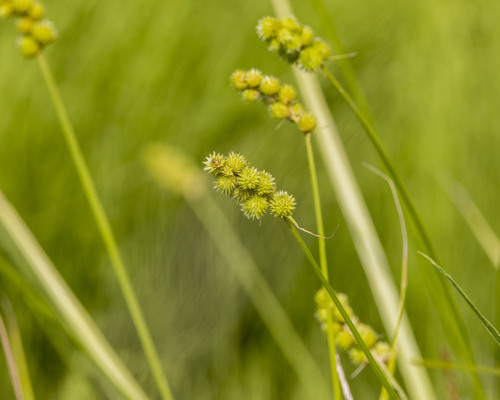
crested sedge
Carex cristatella
Featuring bristly, star-shaped seed heads that look like miniature pineapples, the Crested Sedge is a structural masterpiece of the North American wetlands. This hardy, clump-forming plant is a favorite for backyard bird-watchers and dragonflies alike.
Quick Identification
Size
Height ranges from 30–100 cm (12–39 in); seed heads are 1–2 cm (0.4–0.8 in) in diameter.
Colors
Bright green foliage; seed heads transition from lime green to a warm straw-brown as they mature.
Key Features
- Distinctive spherical, spiked seed heads resembling tiny pineapples
- Perigynia (seed cases) are winged and spread outward or backward
- Stiff, triangular stems typical of the sedge family
- Forms dense, attractive clumps rather than spreading via aggressive runners
When You’ll See Them
Geographic range
Where Does the crested sedge Live?
Crested Sedge is native to the temperate regions of eastern North America. Its core range extends from Quebec and Ontario in the north, stretching down through the Midwestern and Eastern United States to North Carolina and as far west as Nebraska. While primarily a North American species, it has been introduced to parts of Europe where it can occasionally be found in similar wetland habitats.
Basemap © OpenStreetMap contributors
Behavior
Crested Sedge is a perennial wetland plant that follows a steady seasonal rhythm. It emerges in early spring, producing a fountain of lush, light-green leaves that provide essential early-season cover for emerging amphibians and ground-dwelling insects. Unlike many aggressive wetland plants, this species grows in tidy clumps, making it a well-behaved addition to backyard rain gardens or pond edges.
By mid-summer, the plant sends up its flowering stalks. These stalks are topped with tightly packed, globose clusters of seeds. While it doesn't "move" like an animal, it reacts dynamically to its environment, swaying gracefully in the wind and providing a sturdy perch for dragonflies and small songbirds. In the winter, the dried stalks often remain standing, offering structural interest and shelter for overwintering beneficial insects.
EverydayEarth exclusive
Camera Tips
To capture the best images of Crested Sedge, position your camera at a low angle, approximately 1 to 2 feet off the ground. This perspective highlights the unique 'crested' architecture of the seed heads against the sky or a softer background. Because this species thrives in wet soil, ensure your camera tripod or mount is stabilized on a flat stone or a dedicated garden stake to prevent it from sinking or tilting over time.
Lighting is key for this species. Use the 'golden hour'—the hour after sunrise or before sunset—to capture sunlight filtering through the translucent, winged seeds (perigynia). This backlighting creates a glowing halo effect that makes the plant pop in photos. If your camera has a macro setting or a high-resolution sensor, try to frame the shot so the seed heads occupy at least 30% of the frame to show off the intricate, star-like patterns.
Time-lapse mode is particularly rewarding for Crested Sedge. Set your camera to take one photo every few days from late May through August to document the fascinating transition from green, tight buds to the bristly, brown 'pineapples' of late summer. Avoid placing the camera too close to tall, moving grasses that might trigger the motion sensor unnecessarily; instead, clear a small 'viewing window' in front of the lens to keep the focus sharp on the sedge itself.
Frequently Asked Questions
Record crested sedge at your habitat
Connect a camera to start building your own species record — AI identifies every visitor automatically.