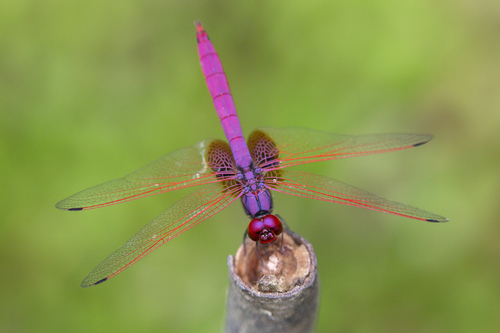
Crimson Marsh Glider
Trithemis aurora
A jewel of the Asian wetlands, the Crimson Marsh Glider dazzles with its vibrant purplish-red hues and acrobatic flight. Often found guarding its territory over garden ponds, this dragonfly is a master of the air and a natural predator of backyard pests.
Quick Identification
Size
Length 25–30 mm (1–1.2 in); Wingspan 45–55 mm (1.8–2.2 in)
Colors
Males are vibrant crimson to purplish-red with reddish wing veins; females are olive-yellow with brown markings and clear wings with amber bases.
Key Features
- Vibrant crimson to purplish body in males
- Distinctive reddish-brown compound eyes
- Broad amber-tinted patches at the base of the hindwings
- Dark mid-dorsal line on the abdomen
When You’ll See Them
Geographic range
Where Does the Crimson Marsh Glider Live?
Native to the diverse landscapes of Asia, the Crimson Marsh Glider is a ubiquitous presence across the Indian subcontinent and Southeast Asia. Its range spans from the wetlands of India and Sri Lanka through the tropical forests of Thailand, Malaysia, and Vietnam, reaching north into southern China and Japan. It thrives in both pristine wilderness and human-altered environments, making it one of the most widely distributed dragonflies in the region.
Basemap © OpenStreetMap contributors
Behavior
The Crimson Marsh Glider is a highly territorial and conspicuous dragonfly, often seen guarding its patch of water with aggressive aerial displays. Males are the more visible of the two sexes, typically choosing a prominent perch like a dry twig, reed, or garden stake overhanging a pond. From this vantage point, they launch swift sorties to intercept prey or chase away competing males, almost always returning to the same favorite spot within minutes.
During the peak heat of the day, these dragonflies often perform 'obelisking'—a thermoregulation behavior where they raise their abdomen vertically toward the sun to reduce the surface area exposed to direct heat. While they are agile flyers, they spend a significant amount of time perching, which makes them excellent subjects for observation. They are generally indifferent to humans as long as movements are slow and non-threatening.
EverydayEarth exclusive
Camera Tips
To capture high-quality images of the Crimson Marsh Glider, your best strategy is to identify its 'sentinel perch.' Because these dragonflies are territorial, a male will repeatedly return to the same twig or reed. Position your camera on a tripod at a height of 2 to 4 feet, roughly level with the tips of emergent vegetation near the water’s edge. Using an AI-powered camera with a macro lens or a close-focusing telephoto lens will yield the best detail of their intricate wing venation.
Lighting is critical for bringing out the male’s stunning purplish-crimson hue. Mid-morning to early afternoon provides the strongest light, which reflects beautifully off their metallic-looking bodies. However, if you are using a camera with motion-triggering features, ensure the sensitivity is set high, as these insects are small. If you don't have a natural pond, placing a few bamboo stakes near a birdbath or small water feature can lure them into a predictable spot for your camera to trigger.
For the best results, use a fast shutter speed (at least 1/1000s) if your camera settings allow, as this will freeze the motion of their wings even when they are just taking off or landing. If you are tracking them in a backyard setting, avoid placing the camera in heavy shade; these dragonflies are 'sun-worshippers' and will almost always choose the most sun-drenched perch available. Be patient—once a Crimson Marsh Glider accepts your garden stake as its territory, it will likely provide hours of photographic opportunities.
Similar Species
Species that look similar or are commonly confused with Crimson Marsh Glider.
Frequently Asked Questions
Record Crimson Marsh Glider at your habitat
Connect a camera to start building your own species record — AI identifies every visitor automatically.