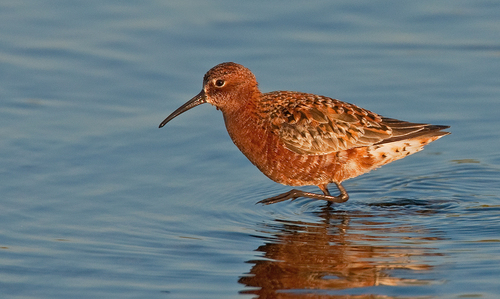
Curlew Sandpiper
Calidris ferruginea
A champion of long-distance flight, the Curlew Sandpiper is a stunning shorebird that travels from the Siberian Arctic to the southern edges of the world. With its elegant curved bill and dramatic red breeding plumage, it is a prized sight for coastal wildlife watchers.
Quick Identification
Size
Length: 18–23 cm (7–9 in); Wingspan: 42–46 cm (16.5–18 in); Weight: 40–100 g (1.4–3.5 oz)
Colors
Breeding adults have deep brick-red face and underparts; non-breeding adults are pale grey above and white below. Juveniles show buff-edged feathers and a peachy wash on the breast.
Key Features
- Distinctively long, slender bill with a downward curve
- Bright white rump visible only in flight
- Elegant, long black legs and slim neck
- Breeding plumage is a rich ferruginous red
When You’ll See Them
Geographic range
Where Does the Curlew Sandpiper Live?
This globe-trotting species begins its life in the high bogs of the Siberian Arctic, particularly the Taimyr Peninsula. As the northern summer fades, it migrates across Eurasia and Africa to winter along the tropical and temperate coasts of Africa, Southeast Asia, and Australasia. While they are common visitors to countries like Australia, South Africa, and India, they are also frequently spotted along the coastlines of the United Kingdom and Europe during their long seasonal transits.
Basemap © OpenStreetMap contributors
Behavior
The Curlew Sandpiper is a world-class traveler, famous for its marathon migrations from the Siberian Arctic to the southern reaches of Africa and Australia. These birds are highly gregarious, often forming large, dense flocks with other shorebirds. Watching them feed is a lesson in efficiency; they move with a rapid, rhythmic 'sewing machine' motion, probing the soft mud for hidden prey with their specialized bills.
While they are intensely focused during feeding, they remain wary of predators and will take flight in a synchronized shimmer if disturbed. On their wintering grounds, their daily rhythm is dictated almost entirely by the tides rather than the sun. They are social birds that rarely vocalize outside of their breeding grounds, except for a soft 'chirrip' call used to keep the flock together during flight.
EverydayEarth exclusive
Camera Tips
To capture the Curlew Sandpiper on camera, you need to understand the tide. These birds follow the water's edge, so position your camera on a low-profile stake or a ground-level sandbag just above the high-tide line on a mudflat or saltpan. Aim the camera to look across the mud rather than straight down; a lens height of 6–10 inches provides a stunning 'eye-level' perspective that makes for professional-grade wildlife photography.
Lighting is your best friend when trying to highlight their plumage. Try to set your camera facing east for afternoon shots or west for morning shots to keep the sun behind the lens. This is particularly important during the spring migration when their brick-red breeding colors are most vibrant. Because they move their heads rapidly while probing, use a high shutter speed or high-definition video setting to prevent motion blur.
Since these birds are sensitive to movement, a stationary AI-powered camera is much more effective than a handheld approach. Use a wide-angle setting if the flock is large, but if your camera has a zoom or telephoto capability, focus on a patch of wet mud that stays moist as the tide recedes—this is where they will spend the most time 'sewing' the ground for worms. Avoid using any bright flashes at night, as this can spook the entire flock; rely on high-quality infrared sensors instead.
Finally, protect your gear! Coastal environments are harsh. Use a silicone protective skin or a weather-sealed housing to guard against salt spray and sand. If you are placing a camera in a public estuary, ensure it is well-camouflaged with local reeds or driftwood to prevent both human interference and avian curiosity.
Similar Species
Species that look similar or are commonly confused with Curlew Sandpiper.
Frequently Asked Questions
Record Curlew Sandpiper at your habitat
Connect a camera to start building your own species record — AI identifies every visitor automatically.