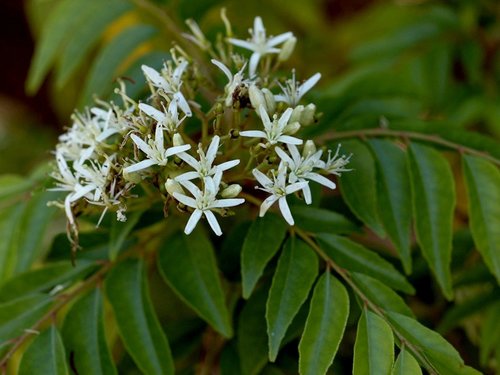
Curry Leaf
Bergera koenigii
A fragrant staple of the spice garden, the Curry Leaf tree is a magnet for beautiful butterflies and a lush addition to any subtropical backyard.
Quick Identification
Size
Small tree reaching 4–6 m (13–20 ft) in height with a trunk up to 40 cm (16 in) in diameter.
Colors
Glossy dark green leaves, fragrant white flowers, and berries that ripen from green to red and finally shiny black.
Key Features
- Aromatic pinnate leaves with 11-21 leaflets
- Small, five-petaled white flowers in clusters
- Shiny black berries containing a single large seed
- Distinctive pungent, spicy fragrance when leaves are crushed
When You’ll See Them
Geographic range
Where Does the Curry Leaf Live?
The Curry Leaf tree is native to the Indian subcontinent and Southeast Asia, with its primary range spanning across India, Sri Lanka, Bangladesh, and Pakistan. It is also found naturally in the warmer regions of southern China, Thailand, and Malaysia. Beyond its native lands, it has been widely introduced and naturalized in tropical parts of Australia, Africa, and the Caribbean, where it thrives in frost-free, humid environments.
Basemap © OpenStreetMap contributors
Behavior
The Curry Leaf tree is a hardy, fast-growing perennial that serves as a cornerstone of many tropical and subtropical backyards. While it can reach the height of a small tree in the wild, it is most often seen as a well-pruned shrub in domestic settings, where frequent harvesting of its leaves encourages denser, bushier growth. It is highly valued not just for its culinary uses, but for its role as a host plant for various pollinators, particularly butterflies in the Papilionidae family.
During the spring and summer months, the tree produces dense clusters of small, bell-shaped white flowers that emit a sweet, heavy fragrance, drawing in bees and butterflies. These are followed by small berries that change color as they ripen. While the tree is evergreen in most tropical climates, it may shed its leaves in cooler subtropical winters or during periods of extreme drought to conserve moisture. It is a social plant in an ecological sense, often forming a micro-habitat for small garden insects and spiders.
EverydayEarth exclusive
Camera Tips
Capturing the Curry Leaf tree on a backyard camera is most rewarding when focusing on the 'visitor economy' it supports. To catch the most action, mount your camera at a height of 3 to 4 feet, aimed directly at the fresh, tender terminal shoots or the flower clusters. These areas are the primary targets for the Lime Butterfly (Papilio demoleus), which lays its eggs on the leaves. Use a macro lens or a close-focus setting if available to capture the intricate details of the caterpillars and emerging butterflies.
If your goal is to record bird activity, shift your camera angle toward the ripening berries during late summer. Use a high-speed trigger setting to capture birds like Bulbuls or Mynas as they land briefly to pluck the fruit. Because the white flowers can easily become 'blown out' in bright sunlight, try to position the camera facing north or south to avoid direct glare, or utilize the soft light of the early morning for the most natural color reproduction.
For a unique perspective, consider a time-lapse project. The Curry Leaf tree grows remarkably fast during the monsoon or rainy season; setting your camera to take one photo every four hours can create a stunning visual of the 'flushing' process, where the tree suddenly explodes with bright lime-green new growth. Ensure your camera housing is well-ventilated, as these trees thrive in the same high-humidity environments that can sometimes cause lens fogging.
Frequently Asked Questions
Record Curry Leaf at your habitat
Connect a camera to start building your own species record — AI identifies every visitor automatically.