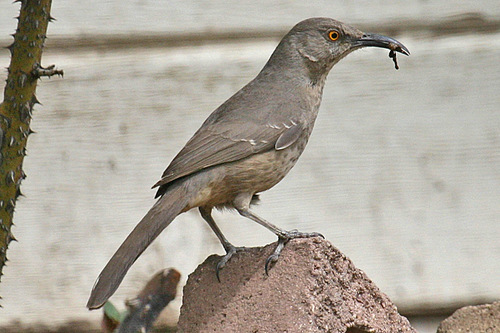
Curve-billed Thrasher
Toxostoma curvirostre
With its iconic sickle-shaped bill and piercing orange eyes, the Curve-billed Thrasher is the bold sentry of the American Southwest. A master of desert survival, this non-migratory bird brings a lively spirit and a human-like whistle to every backyard it visits.
Quick Identification
Size
Length: 25-28 cm (10-11 in); Wingspan: 33-37 cm (13-14.5 in); Weight: 60-94 g (2.1-3.3 oz)
Colors
Uniform grayish-brown upperparts and paler underparts with blurry gray spots. Striking orange-to-red eyes and a dark, curved bill.
Key Features
- Deeply decurved, sickle-shaped black bill
- Distinctive bright orange or golden-red eyes
- Faint, blurry circular spotting on the breast
- Long, rounded tail with white tips on outer feathers
When You’ll See Them
Geographic range
Where Does the Curve-billed Thrasher Live?
Native to the North American continent, the Curve-billed Thrasher is a quintessential resident of the Southwestern United States and the Mexican plateau. Its range extends from Arizona, New Mexico, and Texas southward through the heart of Mexico to the Isthmus of Tehuantepec. As a strictly non-migratory species, it maintains the same territory year-round, making it a reliable sight for backyard observers in desert states.
Basemap © OpenStreetMap contributors
Behavior
The Curve-billed Thrasher is a bold and charismatic bird, often considered the 'personality' of the southwestern desert. Unlike many elusive desert species, this thrasher is quite comfortable around human habitation, frequently seen running across desert soil or perched atop a tall yucca or cactus to deliver its loud, melodious song. They are highly territorial and will aggressively defend their nesting sites, which are almost exclusively built within the protective, spiny arms of cholla cacti.
These birds are famous for their 'thrashing' foraging style. They use their powerful, curved bills to sweep aside leaf litter, dig into the earth, or peck at fallen fruit. Socially, they are usually seen in pairs or as solitary individuals. Their most recognizable vocalization is a sharp, two-noted 'whit-wheet!' whistle that sounds remarkably human, often causing backyard observers to turn around thinking someone is calling for their attention.
EverydayEarth exclusive
Camera Tips
To capture the best footage of a Curve-billed Thrasher, ground-level placement is essential. These birds spend the majority of their time foraging on the floor, using their bills like a pickaxe. Set your camera 6-12 inches off the ground near the base of a Cholla cactus or a brush pile. Using a wide-angle lens is ideal, as they tend to hop close to the camera while investigating the soil for insects.
Water is the ultimate magnet for this species in arid environments. If you have a low-profile bird bath or a dripping water feature, aim your camera there. Thrashers are enthusiastic bathers and will often spend several minutes splashing vigorously, providing excellent action shots. Because they are active during the hottest parts of the day when other birds retreat, ensure your camera has a high-speed shutter setting to handle the bright desert sun without washing out their subtle gray-brown plumage.
If you are using bait to attract them to a specific spot for a photo, suet blocks or orange halves are highly effective. Place the bait behind a natural-looking rock or log so the camera captures the bird in a realistic setting. During the spring (March-June), look for their bulky stick nests in cacti; placing a camera at a respectful distance (at least 10-15 feet) with a zoom lens can capture fascinating parental care behaviors without disturbing the brood.
Similar Species
Species that look similar or are commonly confused with Curve-billed Thrasher.
Frequently Asked Questions
Record Curve-billed Thrasher at your habitat
Connect a camera to start building your own species record — AI identifies every visitor automatically.