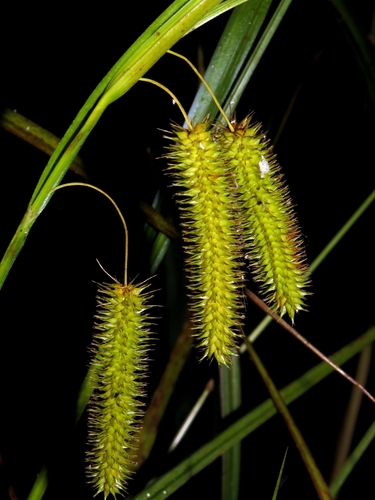
Cyperus Sedge
Carex pseudocyperus
The Cyperus Sedge is a master of the water’s edge, recognized by its distinctive weeping, hop-like seed heads and vibrant yellow-green leaves. It is a vital sanctuary for pond-dwelling wildlife and a favorite for garden enthusiasts looking to add architectural flair to wet spaces.
Quick Identification
Size
Height up to 90 cm (35 in); leaves grow up to 120 cm (47 in)
Colors
Vibrant yellow-green foliage; spikes turn from bright green to a warm golden-brown
Key Features
- Distinctly drooping, hop-like female spikes
- Rough-textured, triangular stems
- Densely tufted clumping growth habit
- Long leaf-like bracts extending past the flower spikes
When You’ll See Them
Geographic range
Where Does the Cyperus Sedge Live?
Native across a vast portion of the Northern Hemisphere, the Cyperus Sedge is found throughout nearly all of Europe, North Africa, and temperate regions of Asia. In North America, it is predominantly established in the northeastern United States and across southeastern Canada, favoring stable freshwater environments. It is a common sight in the British Isles, where it thrives in the stagnant or slow-moving waters of ditches and canals.
Basemap © OpenStreetMap contributors
Behavior
Cyperus Sedge, often called Hop Sedge, is a perennial plant that brings architectural beauty and ecological stability to wetland environments. Unlike many grasses that spread aggressively via runners, this sedge grows in neat, dense tufts. Its most characteristic behavior is the way its heavy seed spikes eventually droop or hang pendulously, a feature that helps distinguish it from many of its upright relatives in the Carex genus.
As a foundational species in backyard ponds and marshes, it provides critical ecosystem services. Its root systems are excellent at stabilizing muddy banks and filtering excess nutrients from the water, which helps prevent algae blooms. For the backyard observer, it acts as a central hub for wildlife, offering a sturdy platform for predatory insects like dragonflies and a cool, moist canopy for amphibians during the heat of the day.
EverydayEarth exclusive
Camera Tips
When setting up a trail camera to capture Cyperus Sedge, think like a macro photographer. Because the plant is stationary, your goal is to document its structural changes and the animals that visit it. Mount your camera on a low stake just 12 to 15 inches above the water line or soil. Angle the lens slightly upward to capture the dramatic, weeping effect of the female spikes against the sky or reflecting in the water. This low-angle placement is also ideal for catching the frogs and newts that frequently seek shelter in the shade of its long, yellow-green leaves.
Lighting is the most important factor for this species. Cyperus Sedge has a unique translucent quality to its leaves; position your camera so it faces the sun during the early morning or late afternoon (backlighting). This 'Golden Hour' light will make the bright green foliage appear to glow, creating stunning, high-contrast images. If your camera allows for manual focus or has a 'macro' mode, use it to highlight the bristly, 'hop-like' texture of the seed heads, which are the plant’s most photogenic feature.
Utilize the time-lapse function on your AI-powered camera to tell the story of a season. Set the camera to take one photo every few hours from late spring through mid-summer. This will allow you to create a video showing the rapid growth of the stems and the heavy transition of the flower spikes from upright buds to drooping, seed-heavy pendulums. During autumn, keep the camera rolling to document the plant's shift to a golden-tan hue, which provides a beautiful textural contrast in your backyard gallery.
Finally, remember that the sedge is a magnet for 'incidental' wildlife. If you place your camera near a healthy clump of Cyperus Sedge, you are almost guaranteed to capture dragonflies, damselflies, and various songbirds that come to forage for insects or use the sturdy stems as a perch. To maximize these captures, ensure the camera is steady and not prone to false triggers from the leaves blowing in the wind—adjusting your PIR sensitivity to a lower setting can help focus the AI on actual animal movement rather than swaying foliage.
Frequently Asked Questions
Record Cyperus Sedge at your habitat
Connect a camera to start building your own species record — AI identifies every visitor automatically.