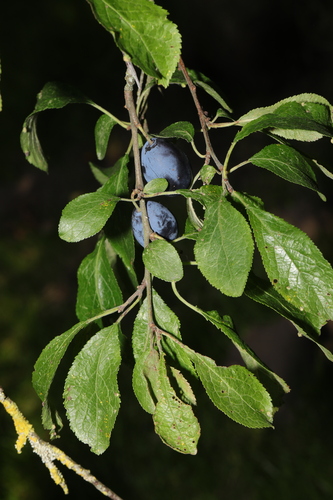
Damson
Prunus insititia
The Damson is a cornerstone of the wildlife garden, offering a spectacular spring blossom show and a bountiful autumn harvest. Its dense, protective branches and tart purple fruits make it a bustling hub for birds, mammals, and insects throughout the year.
Quick Identification
Size
Mature height of 10-20 feet (3-6 meters) with a canopy spread of 10-15 feet (3-4.5 meters)
Colors
Deep indigo-purple or near-black fruit with a waxy blue 'bloom'; bright white blossoms; dark green oval leaves
Key Features
- Small, distinctly oval fruit with a dusty waxy coating
- Dense, twiggy growth habit with occasional small thorns
- Clustered, five-petaled white flowers appearing before or with early leaves
When You’ll See Them
Loading activity data...
Behavior
The Damson is a hardy and resilient deciduous tree, often regarded as a more 'wild' relative of the domestic plum. Unlike commercial plum varieties that require significant maintenance, the Damson thrives in hedgerows and at the edges of woodland, where it grows with a rugged, slightly sprawling habit. It is one of the first trees to signal spring, exploding into a mass of white blossoms that provide an essential early-season nectar source for bees and emerging butterflies.
As the season turns toward autumn, the tree produces a heavy crop of small, tart fruits. While these are famous for jams and gins, they serve as a critical energy source for wildlife preparing for winter. The tree’s growth habit—often dense and multi-stemmed—makes it a preferred nesting site for garden birds, providing excellent protection from aerial predators like hawks.
EverydayEarth exclusive
Camera Tips
Capturing the activity around a Damson tree requires a strategy that evolves with the tree’s phenology. During the spring bloom in April, position your camera using a 'macro' approach or a close-focus lens. Secure the camera to a nearby branch or a heavy-duty stake aimed at a dense cluster of blossoms about 4 to 5 feet off the ground. This is the peak time to capture high-speed action from pollinators. Use a fast shutter speed or a high-frame-rate video setting to document the rapid movements of hoverflies and early-season bumblebees.
When the fruit begins to ripen and drop in late summer, the action moves from the canopy to the ground. This is the best time to use a trail camera to capture 'the fermentation feast.' Mount your camera low—about 12 to 18 inches above the ground—on a tripod or the tree trunk itself, angled slightly downward toward a patch where fallen fruit has gathered. This is a magnet for ground-feeders like Blackbirds, Song Thrushes, and even small mammals like Bank Voles who come to nibble on the sugary skins.
For the most diverse footage, don't stop filming when the sun goes down. Fermenting Damsons on the ground release a scent that attracts nocturnal mammals. Keep your camera in place overnight with the infrared (IR) sensors active. To avoid 'white-out' on the reflective, waxy skins of the fruit, try to position the camera at a 45-degree angle to the target area rather than pointing the flash directly at it. This setup is highly effective for spotting Red Foxes, Badgers, and even the occasional Wood Mouse or Hedgehog scrounging for a late-night snack.
Finally, consider the seasonal lighting. Damson leaves are quite dense, which can create dark shadows even on sunny days. If your camera allows for exposure adjustment, bump it up by +0.5 or +1.0 when filming deep within the canopy. In autumn, ensure the lens is clear of any hanging leaves that might trigger the PIR sensor during a breeze, as the Damson's twiggy nature makes it prone to 'false triggers' in high winds.
Similar Species
Species that look similar or are commonly confused with Damson.
Bullace
Bullaces produce more spherical fruit compared to the distinctly oval-shaped Damson.
Sloe (Blackthorn)
Sloes are much smaller, rounder, and grow on extremely thorny bushes with smaller leaves.
Victoria Plum
Victoria plums are significantly larger, sweeter, and have reddish-mottled skin rather than deep indigo.
Frequently Asked Questions
Record Damson at your habitat
Connect a camera to start building your own species record — AI identifies every visitor automatically.