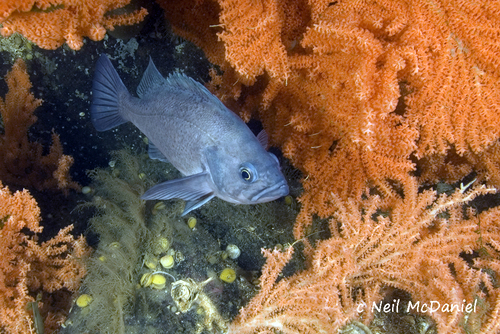
Dark Dusky Rockfish
Sebastes ciliatus
A social master of the North Pacific kelp forests, the Dark Dusky Rockfish is a long-lived sentinel of the deep, known for its striking dark silhouette and impressive schooling behavior.
Quick Identification
Size
Typically 38–48 cm (15–19 inches) in length; maximum weight approximately 1.5 kg (3.3 lbs)
Colors
Uniformly dark greenish-brown to blackish-gray body with a lighter creamy-white belly; fins are usually dark without distinct spotting
Key Features
- Strongly protruding lower jaw
- Uniform dark coloration without prominent mottling
- Slightly forked tail fin
- Clear or dark fin membranes without distinct spots
When You’ll See Them
Geographic range
Where Does the Dark Dusky Rockfish Live?
Native to the cold, nutrient-rich waters of the North Pacific Ocean, the Dark Dusky Rockfish is a staple of the Alaskan marine ecosystem. Its core range extends from the Bering Sea and the Aleutian Islands eastward through the Gulf of Alaska and down the coast of British Columbia. While they are most abundant in the high-latitude waters of the United States and Canada, they are strictly marine and do not have introduced land-based populations.
Basemap © OpenStreetMap contributors
Behavior
Dark Dusky Rockfish are highly social, pelagic fish that are frequently observed in large, dense schools. Unlike many of their bottom-dwelling rockfish cousins, they spend a significant amount of time suspended in the water column, particularly around the edges of kelp forests and rocky reefs where currents bring in fresh supplies of food. They are known for their longevity, with some individuals reaching over 50 years of age, though they grow and mature slowly.
In terms of interaction with humans, they are a popular target for recreational anglers and are generally curious but cautious around divers. They exhibit a distinct 'hovering' behavior, where the school will remain nearly motionless against a current, adjusting their position with subtle pectoral fin movements. They are most active during daylight hours when visibility allows them to spot small prey moving in the current.
EverydayEarth exclusive
Camera Tips
Capturing the Dark Dusky Rockfish requires specialized underwater equipment, as they rarely venture into shallow tide pools. For those with property on a coast or a private dock, an underwater action camera (like a GoPro with a waterproof housing) or a dedicated submersible AI camera is essential. Mount the camera to a weighted tripod or secure it to a dock piling at a depth of 5 to 10 meters, where the light penetration is still high enough to capture their dark silhouettes.
To get the best clarity, aim your camera toward a rocky ledge or the 'fringe' of a kelp forest. These fish love structure but prefer to hang just off the edge of it. Because they are dark-colored, they can be difficult to distinguish from shadows; try to position the camera so that the morning or midday sun is behind the lens, illuminating the fish's subtle greenish-brown scales against the lighter blue of the open water.
While these are plankton eaters, you can encourage them to visit your camera's field of view by using a 'scent lure.' A mesh bag filled with crushed shellfish or fish scraps (chum) will attract the small crustaceans and baitfish that the Dark Dusky Rockfish preys upon. Once the smaller life arrives, the rockfish will follow. Use a wide-angle lens setting to capture the movement of the entire school, as their social behavior is one of their most fascinating traits.
Similar Species
Species that look similar or are commonly confused with Dark Dusky Rockfish.
Frequently Asked Questions
Record Dark Dusky Rockfish at your habitat
Connect a camera to start building your own species record — AI identifies every visitor automatically.