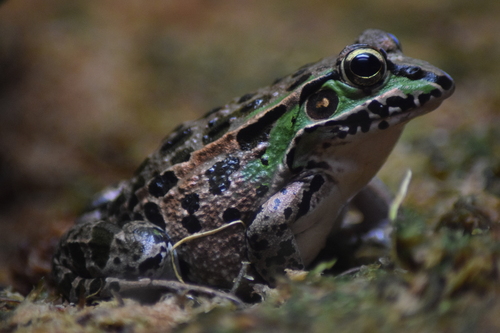
Daruma Pond Frog
Pelophylax porosus
A stout and spirited jumper endemic to Japan, the Daruma Pond Frog is the iconic voice of the traditional rice paddy. With its beautiful spotted pattern and rounded frame, it is a master of the shoreline and a favorite of backyard pond enthusiasts.
Quick Identification
Size
Males range from 3.5 to 6.2 cm (1.4–2.4 in), while females are larger at 3.7 to 7.3 cm (1.5–2.9 in)
Colors
Green to light brown dorsal side with dark irregular spots; creamy white underbelly; often features a light-colored vertebral stripe
Key Features
- Stout, rounded 'Daruma' body shape
- Prominent ridges (dorsolateral folds) along the back
- Distinct dark spotting on a green or tan base
- Shorter hind legs compared to other Japanese pond frogs
When You’ll See Them
Geographic range
Where Does the Daruma Pond Frog Live?
The Daruma Pond Frog is a specialized resident of East Asia, found exclusively within the Japanese archipelago. It is endemic to the islands of Honshu, Shikoku, and Kyushu, where it has historically thrived in the 'satoyama' landscapes of traditional agriculture. While its presence is tied to these lowland regions, its distribution is split between two subspecies: one favoring the Tokyo region and the other found more frequently around Nagoya and western Japan.
Basemap © OpenStreetMap contributors
Behavior
During the breeding season, which typically runs from May to July, the behavior of these frogs becomes much more social and vocal. Males congregate in shallow water, particularly in flooded rice paddies, to produce a rhythmic, croaking chorus designed to attract females. This sound is a classic hallmark of the Japanese countryside. Outside of the breeding season, they are solitary hunters that use a 'sit-and-wait' strategy to catch passing prey.
EverydayEarth exclusive
Camera Tips
If you are setting up in a backyard, you can 'bait' the area indirectly by placing a small solar light near the water's edge. This light will attract nocturnal insects like moths and beetles, which in turn will draw the Daruma Pond Frog into your camera's field of view. Providing a flat 'basking stone' that sits just above the water level can also provide a consistent focal point for your shots, as the frogs will return to the same sunny spot daily.
During the spring breeding season, switch your camera to video mode with audio enabled. The visual of a male frog inflating its vocal sacs is impressive, but the sound of the chorus is what truly brings the footage to life. Use high-quality infrared night vision settings rather than a white flash, as a bright light will often cause the frog to stop calling and dive into the water, ending your recording session prematurely. Ensure your housing is waterproof, as these frogs are most active during the humid, rainy nights of the Tsuyu (rainy season).
Frequently Asked Questions
Record Daruma Pond Frog at your habitat
Connect a camera to start building your own species record — AI identifies every visitor automatically.