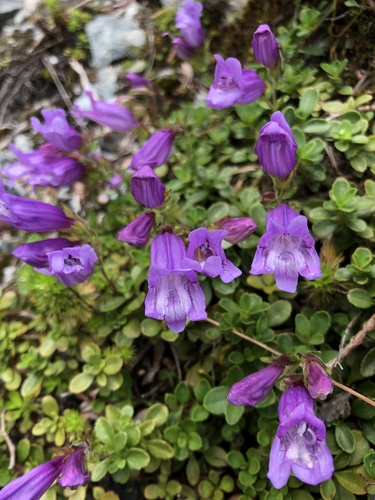
Davidson's Penstemon
Penstemon davidsonii
A hardy alpine treasure, Davidson's Penstemon paints the rocky heights of the West with vibrant violet blooms. This low-growing evergreen mat is a master of survival and a favorite stop for mountain hummingbirds.
Quick Identification
Size
Height: 5-10 cm (2-4 in); Spread: 15-30 cm (6-12 in)
Colors
Brilliant purple, lavender, or blue-violet flowers with dark green, leathery evergreen foliage
Key Features
- Low-growing, mat-forming woody base (subshrub)
- Large, tubular five-lobed flowers reaching up to 3.5 cm long
- Thick, oval-to-round evergreen leaves with smooth or slightly toothed edges
- Stems are creeping and root at nodes, creating a dense carpet
When You’ll See Them
Geographic range
Where Does the Davidson's Penstemon Live?
Davidson's Penstemon is a iconic high-altitude specialist native to the rugged mountain ranges of western North America. Its core range extends from the southern peaks of British Columbia through the Cascade Range of Washington and Oregon, reaching its southern limits in the Sierra Nevada of California and the mountains of western Nevada. This species is almost exclusively found in alpine and subalpine zones where rocky outcrops provide the drainage it craves.
Basemap © OpenStreetMap contributors
Behavior
Davidson's Penstemon is a resilient, mat-forming subshrub that has evolved to thrive in some of the harshest environments in North America. Unlike its taller relatives, this species stays low to the ground to avoid high mountain winds and to trap heat against the rocky substrate. It is a slow-growing perennial that often forms dense, woody cushions in alpine crevices, spreading its stems outward where they occasionally take root upon touching the soil.
During its peak blooming period in mid-summer, the plant undergoes a dramatic transformation, covering its green mats with disproportionately large, showy flowers. These blooms are specifically shaped to facilitate pollination by long-tongued insects and hummingbirds. While it is a rugged survivor in the wild, it is also popular in specialized rock gardens, where it interacts with humans as a prized ornamental for its vibrant color and drought-resistant nature.
EverydayEarth exclusive
Camera Tips
Capturing the beauty of Davidson's Penstemon requires a different approach than tracking mobile wildlife. To get the best results on a trail or backyard camera, place your device very low to the ground—no more than 6 to 10 inches high. Angle the lens slightly upward at a 45-degree angle to capture the 'face' of the tubular blooms and the intricate texture of the evergreen leaves. Because this plant forms low mats, a top-down view often misses the structural elegance of the flowers.
If you are using an AI-powered camera to monitor visitors, set your trigger sensitivity to 'High.' This species is a magnet for high-altitude pollinators like the Rufous Hummingbird and various bumblebee species. By focusing the camera on a particularly dense cluster of buds just before they open, you can record the fascinating interactions between these fast-moving animals and the stationary flowers. Time-lapse mode is also highly recommended; a shot every 15 minutes during the peak of July can create a stunning visual record of the blossoms opening and closing in response to the sun.
Lighting is your biggest challenge and greatest ally. In the high-altitude or rocky backyard environments where Davidson's Penstemon grows, the sun can be incredibly harsh, washing out the delicate purple and blue hues. Position your camera to face North or South to avoid direct lens flare, and aim to capture footage during the 'golden hours' of early morning. The soft, angled light of dawn brings out the deep saturation of the violet petals and the leathery sheen of the foliage without the high-contrast shadows of midday.
Frequently Asked Questions
Record Davidson's Penstemon at your habitat
Connect a camera to start building your own species record — AI identifies every visitor automatically.