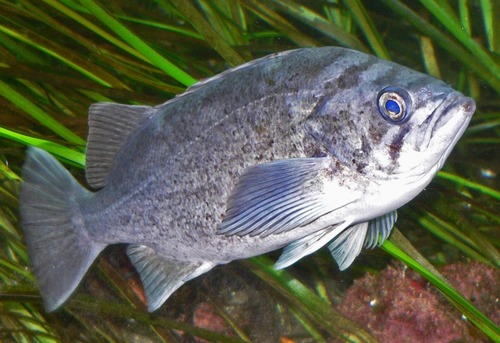
Deacon Rockfish
Sebastes diaconus
The Deacon Rockfish is a master of the Pacific's kelp forests, known for forming massive, charcoal-colored schools that dance through the underwater shadows of the West Coast.
Quick Identification
Size
Reaches lengths up to 53 cm (21 inches) and can weigh between 1.5 and 2.5 kg (3.3 to 5.5 lbs).
Colors
Uniformly dark charcoal, blue-black, or solid grey body with a slightly lighter belly; lacks the distinct spotting or facial stripes of similar species.
Key Features
- Solid dark coloration without distinct blotches or mask-like facial stripes
- Deeply notched tail fin (caudal fin)
- Protruding lower jaw with a small symphyseal knob (chin bump)
- Large, prominent eyes set high on a broad head
When You’ll See Them
Geographic range
Where Does the Deacon Rockfish Live?
Native to the cool, nutrient-dense waters of the Eastern Pacific Ocean, the Deacon Rockfish is a quintessential resident of the North American West Coast. Its core range stretches from the rugged northern shores of British Columbia, Canada, southward through the coastal waters of Washington and Oregon, terminating near San Luis Obispo County in central California. These fish thrive in the productive upwelling zones where the cold California Current supports vast kelp forests and complex rocky reef systems along the continental shelf.
Basemap © OpenStreetMap contributors
Behavior
These fish exhibit complex social dynamics and vertical migration, moving higher in the water column to feed as light levels change. While they are generally peaceful and focus on microscopic prey, they are also quite curious. Divers often find themselves surrounded by curious schools, and the fish will frequently approach underwater cameras to investigate their own reflections or the subtle electrical signals emitted by the equipment.
EverydayEarth exclusive
Camera Tips
To successfully capture the Deacon Rockfish on an underwater trail camera, you must focus on the topography of the seafloor. These fish are 'structure-oriented,' meaning they gravitate toward rocky pinnacles, ledges, and the edges of kelp forests. Mounting your camera on a weighted base or a heavy tripod is essential to prevent the Pacific surge from moving your gear. Position the camera at a depth between 10 and 30 meters, ideally on a reef shelf where the water current brings in planktonic food. Angling the camera slightly upward toward the surface can help capture the distinctive silhouettes of a school as they pass overhead.
While bait isn't always necessary for these curious fish, a 'visual lure' can be highly effective. A small, shiny piece of metal or a white plastic ribbon tied near the camera's field of view can mimic the flash of a small prey fish, drawing the Deacon Rockfish in for a closer look. If you prefer a scent-based approach, a perforated container filled with oily fish parts or shrimp can attract a whole school. However, be prepared for other reef residents like Lingcod or Seals to investigate as well. Setting your camera to record high-frame-rate video (60fps or higher) is recommended to capture the fluid, schooling motions of the fish without blur.
Lighting is the biggest challenge in the Deacon Rockfish’s deep, temperate habitat. If your camera setup allows for external lights, use a wide-angle video light with a 'warm' filter to counteract the heavy green tint of the North Pacific. Avoid using a direct, forward-facing flash, as the suspended particles in the water (marine snow) will reflect the light back into the lens, causing a 'snowstorm' effect known as backscatter. Instead, position lights off to the side at a 45-degree angle. The best time for filming is during high tide when water clarity is usually at its peak and the fish are most active in the kelp canopy.
Similar Species
Species that look similar or are commonly confused with Deacon Rockfish.
Blue Rockfish
Blue Rockfish have distinct dark blotches on their sides and horizontal stripes across the forehead, whereas Deacon Rockfish are more uniformly dark.
Black Rockfish
Black Rockfish have a much larger mouth that extends behind the eye, whereas the Deacon's mouth is smaller and ends before the middle of the eye.
Frequently Asked Questions
Record Deacon Rockfish at your habitat
Connect a camera to start building your own species record — AI identifies every visitor automatically.