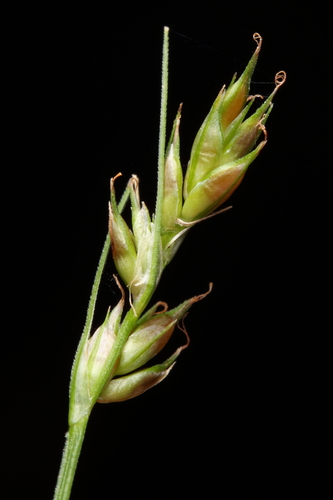
Dewey's sedge
Carex deweyana
A graceful, arching sedge of the deep woods, Dewey's sedge is a master of the shade, providing soft textures and essential cover to North American forest floors.
Quick Identification
Size
Stems reaching 20–100 cm (8–40 in) in length; leaves 2–5 mm wide
Colors
Pale green to yellowish-green foliage with tan or light brown seed spikes
Key Features
- Clump-forming habit with slender, arching stems
- Nodding, pale green flower spikes (infructescence)
- Perigynia are narrow, lance-shaped, and winged at the top
- Soft, floppy leaves that often spread out from the center
When You’ll See Them
Geographic range
Where Does the Dewey's sedge Live?
Dewey's sedge is widely distributed across the northern half of North America. It is a common native resident throughout Canada, from the Atlantic provinces to British Columbia, and extends deep into the United States. Its core range includes the Pacific Northwest, the Great Lakes region, and the Northeast, though isolated populations can be found as far south as the high-altitude woodlands of the American Southwest. This broad range makes it one of the most frequently encountered woodland sedges in temperate and boreal zones.
Basemap © OpenStreetMap contributors
Behavior
Ecologically, Dewey's sedge is a quiet contributor to its environment. It provides essential ground cover for small woodland invertebrates and helps stabilize soil in shaded areas. While it doesn't move in the traditional sense, its life cycle is closely tied to the seasons; it remains semi-evergreen in milder climates, providing a pop of color when other forest plants have gone dormant. It interacts with the local fauna primarily as a source of shelter and occasional forage for small seed-eating birds and mammals.
EverydayEarth exclusive
Camera Tips
Backyard naturalists should focus their efforts on the 'peak' window in late spring when the inflorescence is most vibrant. If your AI-powered camera is looking for movement, the swaying of these slender stems in a light breeze can provide beautiful cinematic footage. For identification purposes, ensure the camera is close enough to resolve the individual perigynia (the seed casings), as these are the primary diagnostic features for distinguishing *Carex deweyana* from its many cousins.
Consider placing your camera near a patch of Dewey's sedge if you are also tracking small mammals like voles or shrews. These animals often use the dense, floppy clumps as transit tunnels or hiding spots. If your camera has a time-lapse mode, use it to document the plant's growth over a month-long period—watching the stems go from upright shoots to heavy, arching seed heads provides a fascinating look at plant phenology that most people never get to see.
Frequently Asked Questions
Record Dewey's sedge at your habitat
Connect a camera to start building your own species record — AI identifies every visitor automatically.