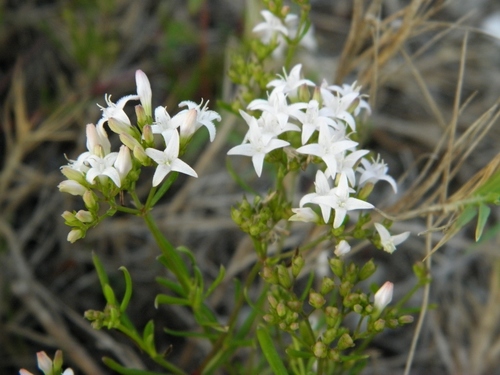
diamond-flowers
Stenaria nigricans
The Diamond-flower is a resilient gem of the American prairie, turning harsh, rocky barrens into shimmering carpets of white and lavender. These sun-loving perennials are the ultimate hosts, supporting a hidden world of native bees and butterflies.
Quick Identification
Size
Height: 15–50 cm (6–20 inches); Flower diameter: 5–8 mm (0.2–0.3 inches)
Colors
White to pale lavender flowers; dark green foliage that turns black when dried
Key Features
- Narrow, needle-like leaves in opposite pairs
- Dense terminal clusters of four-lobed flowers
- Wiry, upright stems frequently found in rocky soil
- Flowers possess a distinctive 'tube' shape at the base
When You’ll See Them
Geographic range
Where Does the diamond-flowers Live?
Native to the North American continent, Diamond-flowers are primarily found across the central and eastern United States and northern Mexico. Their core range extends from the arid landscapes of New Mexico and Texas northward through the Great Plains to Nebraska, and eastward into the limestone-rich regions of the Ozarks and the Appalachian foothills. They are a signature species of 'glade' ecosystems where bedrock is close to the surface.
Basemap © OpenStreetMap contributors
Behavior
These plants serve as vital nectar hubs in arid or rocky micro-habitats where other flora might wither. They attract a specialized group of pollinators, including bee flies, small carpenter bees, and various skippers. Interestingly, the species name 'nigricans' refers to the plant's tendency to turn a deep, coal-black color upon drying or at the end of the growing season, a unique trait among its relatives.
EverydayEarth exclusive
Camera Tips
Capturing Diamond-flowers with an AI-powered camera is less about the plant's movement and more about the incredible 'micro-wildlife' it attracts. To get the best results, set your camera on a macro focal setting and position it roughly 6 to 12 inches from a healthy cluster of blooms. Using a tripod or a ground-stake mount is essential, as these plants grow low to the ground and require a stable low-angle shot to capture the interior of the tube-shaped flowers.
Timing is critical for backyard observers. Because Diamond-flowers thrive in full sun, the best images are often captured during the 'golden hours' of early morning or late afternoon when the light isn't too harsh. Mid-day sun can wash out the delicate pale lavender or white petals. If your camera allows for time-lapse, set it to trigger every 15 minutes during a clear June day to watch the blossoms track the sun and open fully.
For those interested in the 'wildlife' aspect, Diamond-flowers are a magnet for Bee Flies and Clearwing Moths. Use a high shutter speed or a 'burst' trigger mode to catch these fast-moving pollinators in action. Since the plant doesn't move, you can use it as a static 'bait' station; placing the camera facing a south-facing glade or rock garden will yield the highest diversity of insect visitors throughout the summer months.
Similar Species
Species that look similar or are commonly confused with diamond-flowers.
Frequently Asked Questions
Record diamond-flowers at your habitat
Connect a camera to start building your own species record — AI identifies every visitor automatically.