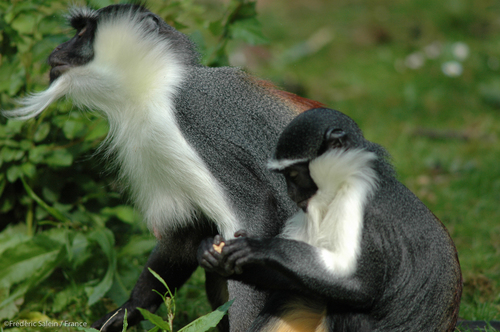
Diana guenon
Cercopithecus diana
The Diana guenon is the regal sentinel of the West African canopy, instantly recognizable by its striking white beard and crescent-moon brow. Elegant and highly vocal, these monkeys are the sophisticated communicators of the rainforest heights.
Quick Identification
Size
Body length 40–55 cm (16–22 in); tail length 50–75 cm (20–30 in); weight 4–7 kg (9–15 lbs)
Colors
Black-grey body with a dark back, white throat, chest, and beard, and a distinctive white crescent on the forehead; rust-orange patches on the inner thighs.
Key Features
- White crescent-shaped browband
- Long, pointed white beard and throat ruff
- Black face with a thin white line above the lip
- Vibrantly colored chestnut or orange thighs
When You’ll See Them
Geographic range
Where Does the Diana guenon Live?
The Diana guenon is native to the lush coastal forests of West Africa. Its range is concentrated within the Upper Guinean forest belt, specifically spanning from the southern tip of Sierra Leone through the dense jungles of Liberia and into the western regions of Côte d'Ivoire. Within these countries, they are almost exclusively found in undisturbed high-canopy habitats, making them an indicator species for the health of the primary rainforest.
Basemap © OpenStreetMap contributors
Behavior
Diana guenons are highly social and intelligent primates that spend nearly their entire lives in the high canopy of the rainforest. They live in groups of 15 to 30 individuals, typically led by a single dominant male who acts as a protector. These monkeys are famous for their complex vocalizations; they have developed specific alarm calls for different types of predators, such as leopards or crowned eagles, and other monkey species even 'listen in' on these calls to stay safe.
As diurnal creatures, they are most active during the day, spending their time foraging and grooming. They are incredibly agile, capable of making massive leaps between tree crowns using their long tails for balance. While they are generally shy and wary of ground-level activity, they are highly curious and will often pause to observe an intruder from the safety of the high branches before sounding an alarm and retreating.
EverydayEarth exclusive
Camera Tips
Capturing the Diana guenon on a trail camera is a unique challenge because they rarely descend to the forest floor. To successfully spot them, you must move your camera off the ground and into the trees. Look for 'arboreal highways'—horizontal branches or thick vines that connect the canopies of large trees. Mounting your camera 10 to 20 feet up a trunk, angled toward these crossing points, is the most effective way to catch them in transit.
Because these monkeys move with sudden, jerky leaps, a camera with a lightning-fast trigger speed (under 0.3 seconds) is essential. Use a 'burst' or 'multi-shot' mode to ensure you get a clear look at their facial markings rather than just a blurry tail. If your camera allows for high-definition video, this is often preferred over stills, as it captures the social dynamics and vocalizations that make this species so fascinating.
Standard white flash can be very disruptive to primate groups and may cause them to abandon a specific trail. Instead, use a 'No-Glow' or 'Black LED' infrared flash. For the best results, position the camera during the dry season when the canopy is slightly less dense, allowing more light to reach your lens. Focus on placing cameras near fruiting trees like wild figs or oil palms, which act as natural magnets for the entire troop.
Frequently Asked Questions
Record Diana guenon at your habitat
Connect a camera to start building your own species record — AI identifies every visitor automatically.