Ditch millet
Paspalum scrobiculatum
A champion of marginal lands, Ditch millet is a resilient grass known for its unique 'ladder-like' seed heads and its ability to thrive in the toughest conditions.
Quick Identification
Size
Height of 60–150 cm (24–60 inches); leaf blades 15–40 cm (6–16 inches) long
Colors
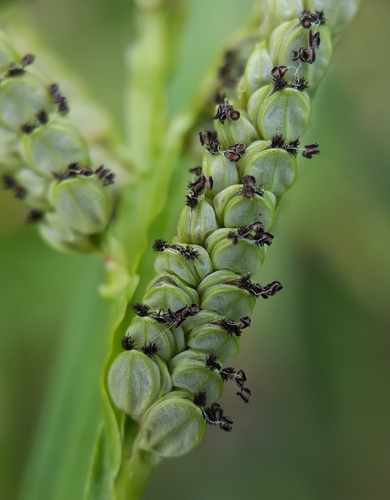
Bright green foliage; seed heads transition from light green to deep brown or purplish-black when mature
Key Features
- Distinctive seed heads with 2–4 rows of circular, lens-shaped grains
- Flattened, ribbon-like racemes (seed stalks)
- Tufted growth habit with slightly thickened, woody bases
- Smooth, hairless leaf sheaths that may have a purple tint
When You’ll See Them
Geographic range
Where Does the Ditch millet Live?
Ditch millet is native to the tropical and subtropical regions of West Africa, where it thrived in seasonally wet environments before spreading globally. Today, its core range extends across the Indian Subcontinent—particularly throughout India and Nepal—and reaches into Southeast Asian nations like the Philippines, Indonesia, Thailand, and Vietnam. It is also found in parts of Northern Australia and has been introduced to various Pacific islands where it often naturalizes in disturbed, moist habitats.
Basemap © OpenStreetMap contributors
Behavior
Ditch millet, often known as kodo millet, is a remarkably resilient annual grass that functions as a survival specialist. In the wild, it is frequently seen colonizing damp depressions and disturbed soils where other plants struggle. Its growth pattern is tufted and upright, though the base of the plant may sprawl across the ground in a decumbent fashion before rising toward the sun.
While it is a domesticated grain in the Deccan plateau of India, its 'wild' behavior is that of a pioneer species. It interacts with its environment by stabilizing muddy soils and providing a high-energy food source for local fauna. For humans, it represents a 'famine crop' due to its ability to produce grain even during severe droughts or in nutrient-poor, acidic soils.
EverydayEarth exclusive
Camera Tips
To capture the architectural beauty of Ditch millet, set your camera at a low angle, roughly 12 inches from the ground. This perspective emphasizes the unique, ladder-like structure of the seed heads against the sky. Use a macro lens or a close-focus setting to document the 'scrobiculated' (pitted) texture of the seeds, which is the plant's most defining visual characteristic.
Since this grass thrives in damp ditches and open fields, it is prone to swaying in the wind. To avoid blurry images on your trail camera, select a fast shutter speed or a 'burst' mode. If your camera allows for manual focus, lock it on the seed head rather than the leaves to ensure the AI can correctly identify the species based on its grain arrangement.
Lighting is crucial for this species; the seeds have a slightly waxy sheen that can reflect harsh midday sun. Aim to capture photos during the 'golden hour'—the hour after sunrise or before sunset. The warm, angled light will highlight the transition from green to deep purple in the ripening grains, providing a much more vivid and professional-looking species profile.
Finally, consider using your camera to monitor the 'visitors' to the millet patch. By placing a camera with a wide-angle lens near a dense stand of Ditch millet during the late autumn, you can capture the various birds and rodents that use the grass for both cover and forage. This provides a complete picture of the plant's role in your local backyard ecosystem.
Frequently Asked Questions
Record Ditch millet at your habitat
Connect a camera to start building your own species record — AI identifies every visitor automatically.