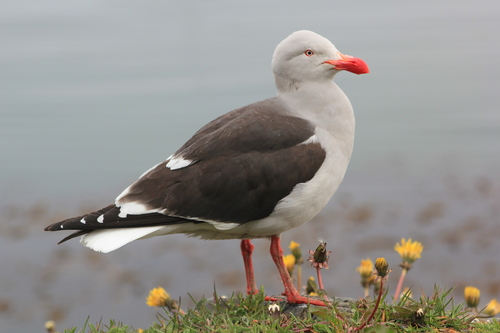
Dolphin Gull
Leucophaeus scoresbii
A striking specialist of the southern coasts, the Dolphin Gull stands out with its vivid crimson bill and sophisticated slate-grey plumage. Found only at the rugged tip of South America, this clever scavenger is a master of the sub-Antarctic shoreline.
Quick Identification
Size
Length of 40–46 cm (16–18 in) with a wingspan of 104–110 cm (41–43 in); weighs approximately 520–550 g (1.1–1.2 lbs).
Colors
Adults feature a pale grey head and neck, dark slate-grey wings and back, and a light grey underbelly. Their most striking feature is the deep blood-red bill and legs. Juveniles are mottled brownish-grey with dark bills.
Key Features
- Bright blood-red bill and legs
- Dark slate-grey wings contrasting with a lighter grey body
- Pale yellow iris with a thin red orbital ring
- Sturdy, deep-based bill shape
When You’ll See Them
Geographic range
Where Does the Dolphin Gull Live?
South America is the exclusive home of the Dolphin Gull, where it thrives along the southern coastlines of Chile and Argentina. Its range is most concentrated around the windswept archipelago of Tierra del Fuego and extends eastward to the Falkland Islands. These birds are year-round residents of these sub-Antarctic regions, rarely wandering north of the 40th parallel south.
Basemap © OpenStreetMap contributors
Behavior
The Dolphin Gull is a bold and highly opportunistic scavenger, often regarded as one of the most specialized gulls in the southern hemisphere. Unlike many of its relatives that scavenge in landfills, this species is intimately tied to the lifecycle of other marine animals. They are frequently found loitering around colonies of penguins, seals, and cormorants, where they expertly steal eggs, scavenge placentas, or even consume the excrement of sea lions for nutrients.
Socially, they are gregarious but aggressive when it comes to food. They utilize a behavior known as kleptoparasitism, where they harass other birds until they drop their catch. Despite their tough reputation, they are also quite vocal and exhibit a variety of complex displays during the breeding season, including a distinct 'long call' accompanied by a bowing motion. They are strictly coastal and rarely venture far out to sea or deep into the interior mainland.
EverydayEarth exclusive
Camera Tips
To capture the stunning contrast of the Dolphin Gull’s red bill against its grey plumage, position your camera at a low 'bird’s-eye' level, roughly 6 to 10 inches off the ground. Placing the camera near the high-tide line on rocky shores or near large kelp wash-ups is ideal, as these birds spend a significant amount of time patrolling the water's edge for stranded invertebrates. Use a wide-angle lens if possible to capture the bird within the context of the dramatic Patagonian landscape.
Because Dolphin Gulls are remarkably bold and curious, they may approach your camera to investigate it. Ensure your housing is secure and the lens is protected from salt spray and pecking. If you are setting up near a known scavenging site, such as a sea lion haul-out or a penguin colony (observing all local distance regulations), use a high-speed trigger setting. These birds move quickly when competing for food, and a fast shutter speed is necessary to freeze the action during their frequent aerial squabbles.
Lighting can be tricky on the often-overcast southern coasts. Aim to capture footage during the 'golden hours' of early morning or late afternoon when the sun is low. This lighting beautifully saturates the red of their bill and legs, which can otherwise look dark or black in poor light. If your camera allows for it, increasing the exposure compensation slightly can help bring out the detail in their dark slate-grey wings without washing out the lighter grey of their heads.
Similar Species
Species that look similar or are commonly confused with Dolphin Gull.
Frequently Asked Questions
Record Dolphin Gull at your habitat
Connect a camera to start building your own species record — AI identifies every visitor automatically.