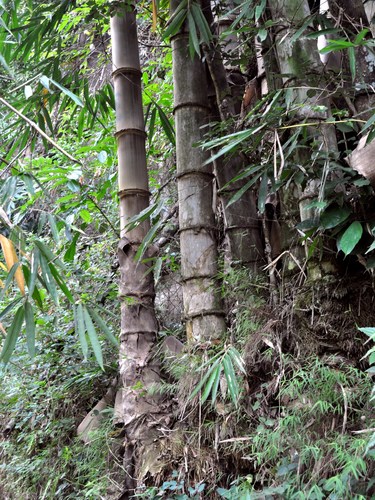
Dragon bamboo
Dendrocalamus asper
A true titan of the grass family, Dragon bamboo features massive, velvety culms that can reach the height of a ten-story building. This non-invasive giant is a sustainable powerhouse, producing edible shoots and some of the strongest timber in the botanical world.
Quick Identification
Size
Height 15–30 m (50–100 ft); culm diameter 8–20 cm (3–8 in)
Colors
Dull green to grayish-green culms; young shoots covered in velvety brownish-black hairs
Key Features
- Massive thick-walled culms up to 100 feet tall
- Clumping (sympodial) growth habit that stays in one place
- Distinctive ring of aerial roots at the lower nodes
- Velvety dark hairs on new emerging shoots
When You’ll See Them
Geographic range
Where Does the Dragon bamboo Live?
Dragon bamboo is native to the humid tropical regions of Southeast Asia, particularly Indonesia, Malaysia, Thailand, and Vietnam. Due to its utility and stunning appearance, it has been introduced extensively to other tropical belts including Brazil, Colombia, and parts of East Africa. In North America, it is commonly cultivated in Mexico and the frost-free regions of southern Florida.
Basemap © OpenStreetMap contributors
Behavior
Dragon bamboo is a sympodial or "clumping" bamboo, which means it grows in tight, predictable colonies rather than spreading aggressively via underground runners. This makes it a favorite for large-scale landscaping and sustainable timber production. During the peak of the rainy season, this species exhibits explosive growth, with new shoots capable of growing over 30 centimeters (12 inches) in a single day. As the culms mature, they develop incredibly thick walls, making them one of the strongest natural building materials on Earth.
While the plant itself is stationary, it acts as a massive vertical ecosystem. It interacts with humans primarily as a source of high-quality edible shoots and structural timber. In a garden or backyard setting, it creates a dense privacy screen and a microclimate that is significantly cooler than the surrounding area. Its massive root system is also excellent for preventing soil erosion, particularly on slopes or near water sources.
EverydayEarth exclusive
Camera Tips
Capturing the majesty of Dragon bamboo requires a different approach than fast-moving wildlife. To document its incredible growth speed, set your camera to Time-Lapse mode rather than Motion Trigger. During the rainy season, place the camera on a sturdy tripod at ground level, focused on a newly emerging shoot. By taking a photo every 30 minutes, you can create a stunning video of the "Dragon" rising from the earth in real-time.
Because these plants can reach heights of 100 feet, standard framing often fails. For a "backyard giant" perspective, place your AI camera at the base of the clump and angle it 45 to 60 degrees upward. This emphasizes the scale of the culms against the sky. If you are using an AI-powered camera to spot wildlife, aim it at the "culm sheaths" or nodes midway up the plant, as these often collect small pockets of water that attract birds and insects.
Be mindful of the wind. Bamboo leaves and branches are highly flexible and will frequently trigger motion sensors on windy days. To avoid thousands of empty videos, reduce the motion sensitivity of your camera or use the "Zone Detection" feature to focus specifically on the base of the plant where animals (or new shoots) are most likely to appear. If you are looking for the animals that live within the bamboo, the early morning hours provide the best lighting for the vibrant greens of the foliage.
Frequently Asked Questions
Record Dragon bamboo at your habitat
Connect a camera to start building your own species record — AI identifies every visitor automatically.