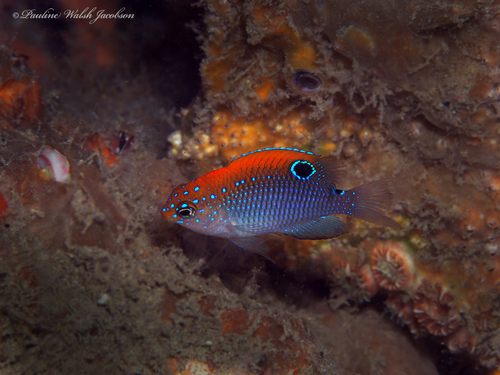
Dusky Damselfish
Stegastes adustus
Meet the reef’s most determined gardener. The Dusky Damselfish is a tiny powerhouse that aggressively 'farms' its own patch of algae in the shallow surge zones of the Caribbean.
Quick Identification
Size
Maximum length of 15 cm (6 inches); commonly 7 to 10 cm (3 to 4 inches)
Colors
Adults are charcoal to dark brown with faint vertical bars; juveniles are bright blue-grey with neon blue spots and a signature scarlet/orange dorsal fin edge.
Key Features
- Deep, oval-shaped body with a single continuous dorsal fin
- Extremely territorial behavior near rocky crevices
- Adults show a dark, 'dusky' uniform coloration
- Juveniles possess a brilliant red or orange 'scarlet' back
When You’ll See Them
Geographic range
Where Does the Dusky Damselfish Live?
The Dusky Damselfish is native to the warm tropical and subtropical waters of the Western Atlantic Ocean. Its primary range includes the Florida Keys, the Gulf of Mexico, and the entire Caribbean Sea, extending southward along the coast of South America to the shores of Brazil. They are almost exclusively found in shallow marine environments where sunlight and wave action promote the growth of their essential algae gardens.
Basemap © OpenStreetMap contributors
Behavior
The Dusky Damselfish is one of the reef's most spirited inhabitants, famously known for its role as an 'underwater farmer.' Each individual aggressively defends a small patch of the reef, usually centered around a crevice or hole, where it cultivates a specific crop of filamentous algae. They are so protective of these gardens that they will chase away much larger fish, sea urchins, and even human divers who stray too close.
Beyond their defensive nature, they are solitary creatures that rarely venture more than a few meters from their home base. Their daily routine consists of 'weeding' their algae patches—removing undesirable species of seaweed to allow their preferred food to grow. This behavior actually helps maintain the health and diversity of the surrounding reef by creating small, high-productivity zones in an otherwise competitive environment.
EverydayEarth exclusive
Camera Tips
Capturing high-quality footage of a Dusky Damselfish requires understanding their 'territorial anchor.' Because these fish are extremely site-attached, you don't need to hunt for them; once you locate a patch of well-maintained turf algae in shallow water (usually 3–6 feet deep), the fish is likely within a few inches of that spot. Position your underwater camera on a weighted tripod or a stable rock nearby, aiming the lens toward the central crevice where the fish retreats.
Because they live in surge zones where wave action is heavy, camera stability is your biggest challenge. Use a low-profile mount to reduce drag from moving water, and ensure your housing is rated for the constant pressure changes of breaking waves. Wide-angle lenses are preferred because you can place the camera very close to the fish's 'farm'—the Dusky Damselfish is surprisingly bold and will often swim right up to the lens to inspect it, thinking it's a potential intruder.
Lighting is best during midday when the sun is directly overhead, as the dark charcoal scales of the adult can look like a flat silhouette in low light. If you are using an AI-powered camera, set it for high-frame-rate video or burst photos, as these fish move with very quick, darting motions. To capture the stunning neon blue and red of a juvenile, look for them in smaller, shallower cracks in the reef further away from the larger, more aggressive adults.
Similar Species
Species that look similar or are commonly confused with Dusky Damselfish.
Frequently Asked Questions
Record Dusky Damselfish at your habitat
Connect a camera to start building your own species record — AI identifies every visitor automatically.