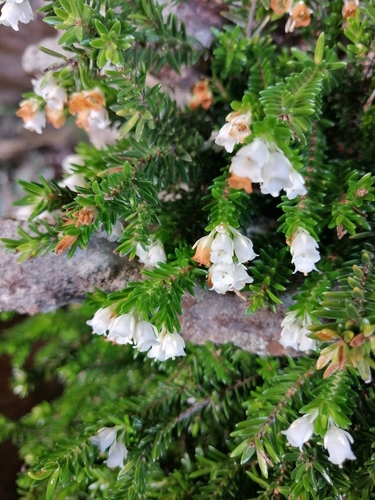
Dwarf Heath
Erica depressa
A resilient survivor of the Cape mountains, the Dwarf Heath is a rare, ground-hugging shrub known for its delicate cream-colored bells and its ability to thrive on windswept rocky ledges.
Quick Identification
Size
A low-growing, prostrate shrub reaching 10–25 cm (4–10 inches) in height with a spreading width of up to 50 cm (20 inches).
Colors
Creamy white to pale yellow tubular flowers; dark, evergreen needle-like foliage.
Key Features
- Low-growing, ground-hugging (prostrate) habit
- Tubular cream-colored flowers approx 10-15mm long
- Small, needle-like leaves in dense whorls
- Woody, resilient stems adapted for rocky terrain
When You’ll See Them
Geographic range
Where Does the Dwarf Heath Live?
Native to the African continent, the Dwarf Heath is a highly localized endemic species found only in the extreme southwest of South Africa. Specifically, its range is restricted to the northern mountain peaks of the Cape Peninsula in the Western Cape province. Within this tiny geographic footprint, it thrives on the rugged slopes of the Table Mountain National Park area.
Basemap © OpenStreetMap contributors
Behavior
Dwarf Heath is a slow-growing, long-lived perennial shrub specifically adapted to the high-wind, low-nutrient environment of the South African fynbos. Unlike many of its upright Erica relatives, it employs a 'depressed' or prostrate growth strategy, clinging closely to sandstone rocks and ledges to avoid the desiccating effects of the Cape's famous winds and to trap heat from the sun-warmed stones.
As an evergreen, it maintains its foliage year-round, but its biological activity peaks during the summer flowering season. During this time, it serves as a nectar source for specialized pollinators, including long-tongued insects and occasionally sunbirds, which are vital for the plant's reproduction in its isolated mountain habitat.
EverydayEarth exclusive
Camera Tips
Photographing the Dwarf Heath requires a specialized approach because of its low-lying nature and the harsh light conditions of its mountain home. Use a camera with a high-quality macro lens or a trail camera with a short focal length. Position your equipment as low to the ground as possible—often just inches above the soil or rock surface—to capture the intricate details of the tubular cream flowers. Using a small beanbag for stability can be more effective than a tripod on the uneven sandstone terrain where this species lives.
Because the Western Cape is prone to heavy winds, motion blur is your biggest challenge. If using a trail camera, set it to the fastest possible shutter speed. If you are setting up a time-lapse to capture the flowering process, aim for the early morning hours (6 AM to 9 AM) when the mountain air is typically at its calmest. This 'golden hour' also provides a softer light that prevents the waxy flowers from appearing washed out or overexposed.
To capture the wildlife that interacts with the Dwarf Heath, set your AI-powered camera to its highest sensitivity. This plant is a magnet for small insects and the occasional Cape Sugarbird or Sunbird. Ensure your camera is well-camouflaged and securely anchored, as the exposed rocky ledges where this plant grows are subject to extreme weather. Using a polarizing filter can also help reduce the glare from the waxy leaves and the surrounding quartz-heavy sandstone.
Similar Species
Species that look similar or are commonly confused with Dwarf Heath.
Frequently Asked Questions
Record Dwarf Heath at your habitat
Connect a camera to start building your own species record — AI identifies every visitor automatically.