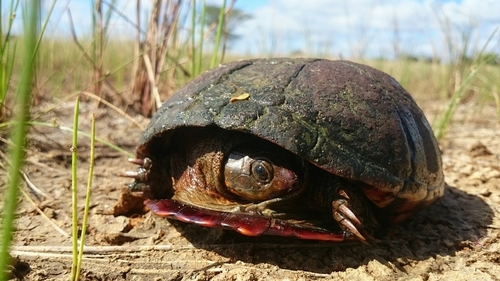
East African Black Mud Turtle
Pelusios subniger
A resilient wanderer of the African wetlands, the East African Black Mud Turtle is a master of survival. With its secretive nature and remarkable hinged shell, this ancient reptile is a fascinating subject for any backyard wildlife explorer.
Quick Identification
Size
Carapace length 13–20 cm (5–8 inches); weight typically between 400 and 900 grams (0.9–2 lbs)
Colors
Dark brown to charcoal-black carapace; yellowish or creamy plastron with dark seams; greyish-brown skin with lighter accents on the head
Key Features
- Hinged front section of the plastron allows the shell to close
- Smooth, oval carapace without a central ridge or keel
- Two small fleshy barbels under the chin
- Five claws on each webbed forefoot
When You’ll See Them
Geographic range
Where Does the East African Black Mud Turtle Live?
Native to the African continent, the East African Black Mud Turtle thrives throughout eastern and southeastern regions. Its core range spans from Burundi and Tanzania in the north, stretching southward through Mozambique, Zimbabwe, and into South Africa. Beyond the mainland, this resilient species is a common sight in Madagascar and the Seychelles, and it has been successfully introduced to other Indian Ocean islands such as Mauritius and the Chagos Archipelago.
Basemap © OpenStreetMap contributors
Behavior
The East African Black Mud Turtle is a semi-aquatic specialist known for its incredible resilience in fluctuating environments. Unlike more permanent water-dwelling turtles, this species is frequently found in temporary pools, marshes, and slow-moving drainage ditches. They are somewhat secretive and shy; when threatened, they utilize a unique hinge on their lower shell (plastron) to pull the front section upward, protecting their head and front limbs from predators.
These turtles are opportunistic and spend much of their time foraging along the muddy bottoms of shallow water bodies. During the intense heat of the African dry season, they exhibit a behavior called estivation, where they burrow deep into the sun-baked mud to remain dormant until the rains return. They are most active during the twilight hours and at night, though they can often be spotted basking on logs or mudbanks during the early morning to regulate their body temperature.
EverydayEarth exclusive
Camera Tips
Capturing the East African Black Mud Turtle on camera requires a strategic approach focused on the water-land interface. Set your AI-powered camera at a very low angle—no more than 10 to 15 centimeters (4–6 inches) off the ground—near the muddy edges of a pond or marsh. Because these turtles are relatively small and move slowly, ensure your camera’s trigger speed is fast and the sensitivity is set to 'High' to detect their cold-blooded movement against the warmer ground.
For the best results, place your camera near a popular basking spot, such as a partially submerged log or a flat, sunny bank. If you are trying to attract one to a specific spot in a backyard setting, a small 'scent trail' using oily fish or canned cat food near the water's edge can be highly effective. They are particularly active during and immediately after rainfall, so check your equipment when the weather is damp, as this is when they are most likely to move overland between water sources.
Nighttime is a prime opportunity to see their foraging behavior. Ensure your camera has high-quality infrared (IR) LEDs to capture clear black-and-white footage without startling the turtle. Since they often stop to investigate potential food sources, consider using the 'Hybrid' mode on your trail camera—this will capture a high-resolution still image followed by a 10-20 second video clip, giving you the best chance to observe their unique shell movements and feeding habits.
Frequently Asked Questions
Record East African Black Mud Turtle at your habitat
Connect a camera to start building your own species record — AI identifies every visitor automatically.