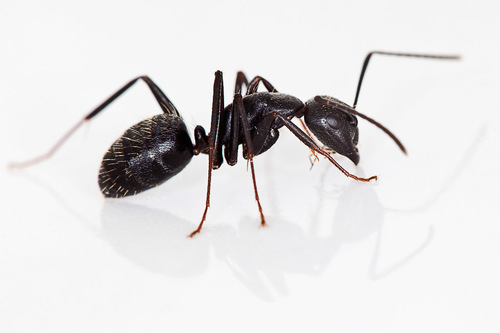
Eastern Black Carpenter Ant
Camponotus pennsylvanicus
The Eastern Black Carpenter Ant is the heavyweight of the North American insect world. A master of social organization and forest architecture, this nocturnal giant plays a crucial role in recycling nutrients within our backyards.
Quick Identification
Size
Workers range from 6–13 mm (0.25–0.5 inches); Queens can reach up to 20 mm (0.75 inches)
Colors
Uniformly dull black body; abdomen often covered in fine, yellowish-white hairs
Key Features
- Large body size with a robust build
- Heart-shaped head with prominent mandibles
- Thorax profile forms a perfectly smooth, continuous curve
- Single node (petiole) between the thorax and abdomen
When You’ll See Them
Geographic range
Where Does the Eastern Black Carpenter Ant Live?
Native to the North American continent, the Eastern Black Carpenter Ant is a staple of the eastern and central regions. Its territory spans from the Atlantic coast westward to the edge of the Rocky Mountains, covering nearly the entire Eastern United States. Their range also pushes significantly north into the Canadian provinces of Ontario, Quebec, and New Brunswick, thriving anywhere that deciduous forests and suburban landscapes provide ample wooden nesting sites.
Basemap © OpenStreetMap contributors
Behavior
Eastern Black Carpenter Ants are highly social insects that live in complex colonies centered around a single queen. Unlike many other ants, they are primarily nocturnal, with their activity levels peaking during the night as they follow well-established pheromone trails to find food sources. They are famous for their woodworking abilities, though a common misconception is that they eat wood; in reality, they simply excavate it to create smooth, clean galleries for their nests.
Within the colony, these ants display polymorphism, meaning workers come in different sizes to perform various roles. Large 'Major' workers act as soldiers and heavy lifters, while smaller 'Minor' workers focus on nursing the brood and detailed foraging. In the backyard, they are often seen 'farming' aphids on plants, protecting the smaller insects in exchange for the sugary honeydew they secrete.
EverydayEarth exclusive
Camera Tips
To capture the Eastern Black Carpenter Ant on camera, you need to think small and focus on high-traffic areas. Look for 'ant highways'—visible paths along the ridges of tree bark, fence rails, or the foundation of your home. Because they are most active at night, ensure your camera's infrared (IR) sensors are optimized for close-range detection. A macro lens attachment is highly recommended to turn these 13mm insects into giant, high-definition subjects on your screen.
Baiting is the most effective way to get a clear, stationary shot. Place a small amount of honey, maple syrup, or sugar water in a shallow bottle cap and mount your camera just 4 to 6 inches away. If you are using a trail camera, ensure it has a 'close-focus' setting or use a clip-on magnifying lens. Position the camera at a side-on angle rather than looking straight down; this captures the ant’s distinctive silhouette and its rounded thorax, which is a key identification mark.
Timing is critical for these nocturnal foragers. Set your camera's schedule to trigger most frequently during the humid hours after sunset, especially after a light rain when the colony's activity often spikes. In the late spring (typically May or June), keep an eye out for winged 'alates' or swarmers. If you catch these on camera, you are witnessing the colony's reproductive cycle as new kings and queens take flight to start their own nests.
Frequently Asked Questions
Record Eastern Black Carpenter Ant at your habitat
Connect a camera to start building your own species record — AI identifies every visitor automatically.