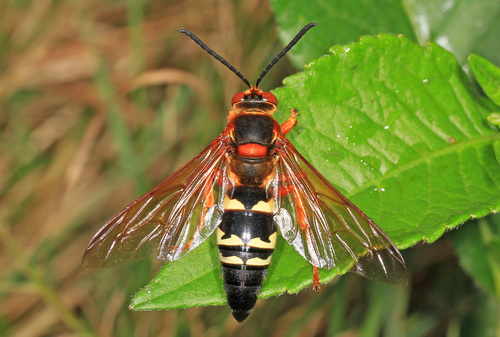
Eastern Cicada-killer Wasp
Sphecius speciosus
The Eastern Cicada-killer is one of North America's largest and most misunderstood wasps. A solitary giant, this fascinating insect performs a vital role in balancing forest ecosystems by hunting the loudest singers of the summer canopy.
Quick Identification
Size
Length: 30–50 mm (1.1–2.0 inches); Wingspan: up to 75 mm (3 inches)
Colors
Dark brown to black body with prominent yellow abdominal bands; wings have a distinct amber or reddish-brown tint; legs are often a rusty-red color.
Key Features
- Extraordinary size, up to 2 inches long
- Abdomen features jagged yellow and black bands
- Translucent amber-colored wings
- Large, prominent eyes and reddish-brown thorax
When You’ll See Them
Geographic range
Where Does the Eastern Cicada-killer Wasp Live?
Native to the North American continent, the Eastern Cicada-killer Wasp is most prevalent across the Eastern and Central United States, extending from the Atlantic coast westward to the edge of the Rocky Mountains. Their presence reaches northward into southern Ontario, Canada, and southward through the Gulf States into Northeastern Mexico and parts of Central America. They are most commonly found in regions where deciduous trees are abundant, providing a steady supply of their primary prey: the annual cicada.
Basemap © OpenStreetMap contributors
Behavior
Despite their intimidating size, Eastern Cicada-killers are the gentle giants of the wasp world. They are solitary creatures, meaning they do not live in colonies or defend a central hive like yellowjackets. Males are famously territorial and will 'buzz' anything that enters their airspace—including humans—to defend their patch of ground. However, males lack a stinger and are completely harmless; their aggressive display is a bluff designed to deter rivals and predators.
Females are the primary architects and hunters, spending their short summer lives excavating deep burrows in well-drained, sandy soil. They are highly specialized predators that track down annual cicadas in the treetops. After paralyzing a cicada with a surgical sting, the female must fly or drag the heavy prey—which can weigh twice as much as she does—back to her burrow. This Herculean effort is one of the most spectacular sights in the backyard insect world.
Human interactions are overwhelmingly peaceful. These wasps are focused on their work and rarely sting unless they are handled roughly or stepped on. Because they provide natural pest control and help aerate the soil, they are considered beneficial insects for gardeners and homeowners.
EverydayEarth exclusive
Camera Tips
To capture the dramatic life of an Eastern Cicada-killer, you need to focus your camera on the ground rather than the air. Look for 'mounds' of loose soil with a hole about the size of a nickel in sunny, sandy patches of your yard. These are the burrow entrances. Position your camera on a low tripod or use a ground stake, placing it approximately 2 to 3 feet from the entrance. A slight downward angle is best to capture the female as she returns from a hunt, dragging her heavy cicada prey into the tunnel.
Because these wasps are incredibly fast and active during the peak heat of the day, use a high-speed trigger setting or, better yet, high-definition video mode. If your camera allows for manual settings, a high frame rate (60fps or higher) is essential to catch the rapid wing beats and the struggle of the 'cicada-drag' without motion blur. Ensure your camera is not pointing directly into the midday sun to avoid lens flare and 'blown-out' highlights on their reflective wings.
While you don't need traditional bait, you can increase your chances of a great shot by identifying 'activity zones.' Males often patrol the same small patch of air every day; if you see one hovering consistently, set your camera to focus on that specific airspace. For females, a nearby patch of nectar-rich flowers like Goldenrod or Milkweed serves as a natural 'lure' where they stop to refuel between digging and hunting sessions.
The peak season is relatively short, typically lasting from late July through August. During this window, check your camera daily. The most dramatic footage—the provisioning of the nests—happens in a burst of energy over just a few weeks. For the best lighting, aim for mid-morning or late afternoon when the lower sun angle helps define the texture of the excavated soil and the metallic sheen of the wasp's body.
Similar Species
Species that look similar or are commonly confused with Eastern Cicada-killer Wasp.
Frequently Asked Questions
Record Eastern Cicada-killer Wasp at your habitat
Connect a camera to start building your own species record — AI identifies every visitor automatically.