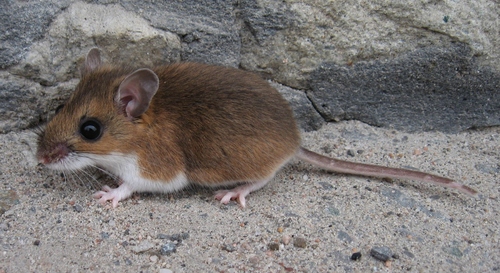
Eastern Deermouse
Peromyscus maniculatus
With its oversized ears and striking white underbelly, the Eastern Deermouse is the most common—and charming—nocturnal acrobat in North America's eastern woodlands.
Quick Identification
Size
Total length: 12-23 cm (4.7-9 in); Weight: 12-35 g (0.4-1.2 oz)
Colors
Rich tawny to grayish-brown upper body with a sharply defined, snow-white underbelly and white feet.
Key Features
- Distinctly bicolored tail, dark on top and white below
- Large, prominent black eyes adapted for night vision
- Oversized, thin, rounded ears
- Stark white underbelly and paws
When You’ll See Them
Sightings on EverydayEarth
Feb 25, 2026
An Eastern Deermouse is foraging in a bird feeder tray filled with seeds and mealworms during the night. It is partially visible at the bottom right edge, where it moves its paws and tail while searching for food.
Feb 25, 2026
An Eastern Deermouse is actively foraging in the bird feeder tray during the night. It is seen digging through seeds and mealworms, with its ears and head frequently appearing over the back rim and movement visible beneath the food in the foreground.
Feb 25, 2026
An Eastern Deermouse is observed cautiously peeking over the back rim of the bird feeder tray during the night. It quickly retreats and then reappears briefly, exhibiting typical wary foraging behavior.
Feb 25, 2026
Two Eastern Deermice are observed at a bird feeder during the night. One is actively foraging among the seeds and mealworms in the tray, while the other briefly peeks over the back edge.
Feb 25, 2026
An Eastern Deermouse is actively foraging in the bird feeder tray, moving through the seeds and mealworms at night.
Feb 25, 2026
An Eastern Deermouse is foraging through seeds and mealworms in the bird feeder tray under the cover of night.
Geographic range
Where Does the Eastern Deermouse Live?
Native to the North American continent, the Eastern Deermouse is a quintessential resident of the eastern half of the United States and central to eastern Canada. Its territory extends from the Atlantic coast westward to the Mississippi River, thriving in both the boreal forests of the north and the temperate woodlands of the Midwest. While they are found throughout most of this region, they are generally absent from the low-lying coastal plains and humid swamps of the deep southeastern United States.
Basemap © OpenStreetMap contributors
Recorded on EverydayEarth
Behavior
The Eastern Deermouse is a highly energetic and agile nocturnal rodent. Unlike the common house mouse, which is often associated with human structures, deermice are true woodland spirits that spend their nights navigating the forest floor and climbing trees with surprising grace. They are meticulous groomers, keeping their soft fur clean and dry, which is essential for survival in the fluctuating temperatures of eastern North America.
During the winter months, these mice do not hibernate; instead, they enter a state of torpor during the coldest hours to conserve energy. They are known for their social nesting habits during this time, often huddling together in communal nests of 10 or more individuals to share body heat. They are also prolific "cachers," spending the autumn months creating hidden pantries of seeds and nuts to sustain them through the frost.
EverydayEarth exclusive
Camera Tips
Capturing the Eastern Deermouse requires a strategy focused on 'micro-trails.' These rodents are creatures of habit, often following the same runways along the sides of fallen logs, stone walls, or the edges of garden beds. To get the best shots, place your camera extremely low—no more than 4 to 6 inches off the ground—and angle it slightly downward. If your camera has a 'macro' or close-focus mode, this is the perfect time to use it, as these small subjects can easily appear out of focus if they get too close to a standard lens.
Because they are strictly nocturnal, your camera’s infrared (IR) flash is the star of the show. To prevent the 'white-out' effect common with small, white-bellied animals, try to place the camera about 3-5 feet away from the target area rather than right on top of it. You can create a 'stage' by placing a flat stone or an interesting piece of driftwood in the frame and dabbing a tiny amount of peanut butter or scattering a few sunflower seeds in the center. This encourages the mouse to pause and interact with the environment, giving the sensor time to trigger and the camera time to focus.
Suburban backyard enthusiasts should look for high-traffic zones like the base of bird feeders or woodpiles. These areas are magnets for deermice. Set your camera to take a three-shot burst or a short 10-second video. Deermice are incredibly fast; a single photo often results in nothing but a blurry tail. In the autumn, keep your eyes peeled for 'pantry' behavior, where you might catch them carrying multiple seeds at once in their cheek pouches to a hidden cache.
Similar Species
Species that look similar or are commonly confused with Eastern Deermouse.
Frequently Asked Questions
Record Eastern Deermouse at your habitat
Connect a camera to start building your own species record — AI identifies every visitor automatically.