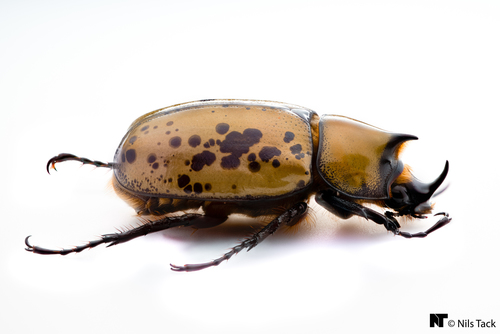
Eastern Hercules Beetle
Dynastes tityus
A prehistoric titan of the backyard, the Eastern Hercules Beetle impresses with its massive size and remarkable color-shifting shell.
Quick Identification
Size
Adults typically measure 40-60 mm (1.6-2.4 inches) in length, with larvae reaching up to 100 mm (4 inches).
Colors
Elytra (wing covers) are greenish-gray, tan, or yellow with irregular black spots. Males feature large black horns, while females lack horns and are generally darker.
Key Features
- Prominent pincer-like horns on males (one on the head, one on the thorax)
- Spotted wing covers that turn darker in high humidity
- Large, bulky body with a smooth, polished texture
- Hooked tarsi (feet) designed for gripping tree bark
When You’ll See Them
Geographic range
Where Does the Eastern Hercules Beetle Live?
Native to the North American continent, the Eastern Hercules Beetle is a hallmark species of the Eastern United States. Its range spans from southern New York and Illinois down to the coastal plains of Florida, stretching as far west as eastern Texas and Oklahoma. It is most commonly found in humid, temperate deciduous woodlands where hardwood trees provide the necessary decaying matter for its multi-year larval cycle.
Basemap © OpenStreetMap contributors
Behavior
Eastern Hercules Beetles are the gentle giants of the North American insect world. Despite the male's formidable-looking horns, which are used primarily for jousting with other males over mates, they are completely harmless to humans and do not bite or sting. They spend much of their adult life high in the canopy of deciduous forests but are frequently encountered by people when they are drawn to bright porch lights at night.
One of the most fascinating aspects of their behavior is their 'hygrochromic' shell. The beetle's wing covers change color based on the humidity of the surrounding air; in dry conditions, they appear light gray or yellow, but as moisture levels rise, the shell absorbs water and turns a deep, dark brown or black. This is thought to be an adaptation for camouflage in damp environments.
While they are mostly solitary, you may find several individuals congregating around a single sap leak or a source of fermenting fruit. They are primarily nocturnal, becoming active shortly after dusk to feed and find mates during the hottest months of the summer.
EverydayEarth exclusive
Camera Tips
To capture the Eastern Hercules Beetle on a backyard camera, you need to leverage their attraction to light and scent. Setting up a 'moth light'—a simple white sheet illuminated by a UV or mercury vapor light—is the most reliable way to bring them into view. Position your camera on a tripod facing the sheet at a distance of about 3-5 feet. Because these beetles are heavy flyers and often 'crash land,' ensure the camera's field of view includes the ground immediately beneath the light source.
If you prefer a more natural setting, look for 'sap bleeds' on mature oak or ash trees. These are spots where sap is oozing from the bark, often attracting a variety of insects. Mount your camera approximately 2 feet from the sap leak. Because the beetle's shell is highly reflective, an intense infrared flash can cause overexposure. To fix this, place a small piece of semi-transparent tape over your camera's IR flash to diffuse the light, or angle the camera at 45 degrees to the surface to minimize direct bounce-back.
Baiting is an excellent strategy for this species. Mix mashed overripe bananas with brown sugar and a little bit of active yeast or beer. Smear this mixture onto the side of a tree at eye level and point your camera at the bait. The fermenting scent mimics the beetles' natural food sources and will often keep them stationary long enough for high-quality photos. Late July is the peak of their activity, especially on warm, humid nights after a rainstorm.
Frequently Asked Questions
Record Eastern Hercules Beetle at your habitat
Connect a camera to start building your own species record — AI identifies every visitor automatically.