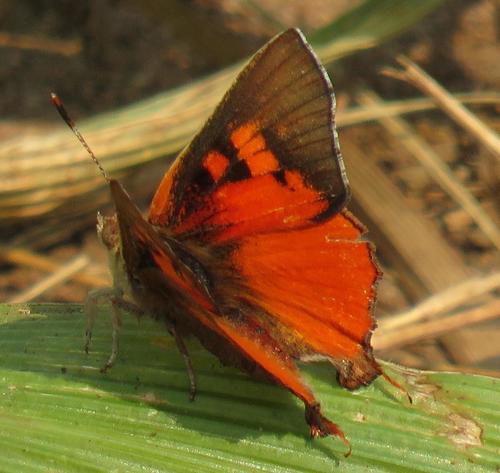
Eastern Scarlet
Axiocerses tjoane
A flash of brilliant crimson in the African sun, the Eastern Scarlet is a high-energy gem of the savanna. Whether patrolling its territory or nectaring on garden blooms, this small but bold butterfly is a favorite for backyard observers.
Quick Identification
Size
Wingspan of 24–32 mm (1.0–1.25 inches)
Colors
Brilliant scarlet to orange-red upperside with broad black borders; cryptic mottled reddish-brown underside with silver-white spots
Key Features
- Vibrant scarlet upperside with thick black wing margins
- Cryptic, leaf-like underside for camouflage when resting
- Small, delicate tails on the hindwings
- Rapid, jerky, and territorial flight pattern
When You’ll See Them
Geographic range
Where Does the Eastern Scarlet Live?
The Eastern Scarlet is native to the sun-drenched landscapes of East and Southern Africa. Its core range begins in the north around Kenya and Tanzania, extending southwards through Malawi, Zambia, Zimbabwe, and Mozambique. It is also a very common sight across the northern and eastern regions of South Africa, Botswana, and northern Namibia, where it thrives in both wild bushveld and well-planted suburban environments.
Basemap © OpenStreetMap contributors
Behavior
The Eastern Scarlet is a spirited and highly territorial butterfly often found patrolling the sunny edges of woodlands and suburban gardens. Males are particularly well-known for their 'perch and patrol' strategy; they select a prominent leaf or twig as a lookout post and will aggressively chase away any flying intruders, including larger butterflies and dragonflies, before returning to the exact same spot.
A fascinating aspect of this species' life cycle is its symbiotic relationship with ants. During their larval stage, the caterpillars produce a sugary secretion that ants find irresistible. In exchange for this food, the ants act as a private security force, protecting the caterpillars from parasitic wasps and other predators. As adults, these butterflies are sun-lovers, spending the peak heat of the day basking with their wings partially open to regulate their body temperature.
EverydayEarth exclusive
Camera Tips
To capture the Eastern Scarlet on your backyard camera, focus on 'nectar highways'—groups of flowering plants like Cape Honeysuckle, Plumbago, or Buddleja. Since these butterflies are small and move quickly, place your camera within 1 to 2 feet of the blooms if possible, using a macro lens or a camera with a short focal length. Mounting the camera at a height of about 1 meter, angled slightly downward, will help you catch the butterfly when it lands to feed.
Because the Eastern Scarlet is territorial, you can often predict where it will land. Look for a male's favorite 'sentry post'—usually a bare twig at the edge of a bush in full sun. Pointing your camera at these specific perches significantly increases your chances of getting a clear, stationary shot. Set your camera to its fastest shutter speed or 'Burst Mode' to freeze their rapid wing beats and capture the brilliant red of the upperside before they fold their wings and vanish into camouflage.
Timing is critical for this species. They are ectothermic and require the sun's heat to fly, so set your active recording windows between 10 AM and 2 PM. Bright, clear days provide the best lighting to make their scarlet scales 'pop' against the green foliage. Avoid placing cameras in deep shade, as these butterflies rarely settle in low-light areas. If you have Acacia trees nearby, placing a camera on a low-hanging branch may also capture them searching for egg-laying sites.
Similar Species
Species that look similar or are commonly confused with Eastern Scarlet.
Frequently Asked Questions
Record Eastern Scarlet at your habitat
Connect a camera to start building your own species record — AI identifies every visitor automatically.