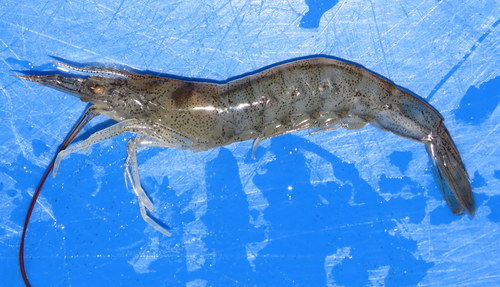
Eastern school shrimp
Metapenaeus macleayi
A staple of Australia's eastern estuaries, the Eastern school shrimp is a master of camouflage that comes to life under the cover of darkness. Watch for their iridescent blue tail tips and rhythmic 'boiling' runs during the summer migration.
Quick Identification
Size
Length up to 16 cm (6.3 inches) for females; males slightly smaller, typically reaching 13 cm (5.1 inches).
Colors
Translucent cream to off-white with fine brown or olive speckling; distinctive iridescent blue or green highlights on the tips of the tail fan.
Key Features
- Sharply pointed rostrum with teeth only on the upper edge
- Translucent body with brownish speckles
- Vibrant blue or green tips on the tail fan (uropods)
- Slightly compressed body shape with long antennae
When You’ll See Them
Geographic range
Where Does the Eastern school shrimp Live?
This species is a quintessential Australian native, strictly endemic to the eastern coastline of the continent. Their core range extends from the warm waters of Tin Can Bay in Queensland down through the temperate estuaries of New South Wales to the Nooramunga region in eastern Victoria. Because they rely on specific estuarine nursery grounds, they are rarely found far from the coast or outside this specific eastern seaboard stretch.
Basemap © OpenStreetMap contributors
Behavior
The Eastern school shrimp is a highly social crustacean known for forming massive, dense aggregations, particularly during their migration from estuaries to the open ocean. They are primarily nocturnal, spending their daylight hours buried just beneath the surface of sandy or muddy substrates to avoid predators like flathead and mulloway. At night, they emerge to forage across the riverbeds and seafloors.
As they grow, these shrimp participate in a fascinating schooling behavior triggered by heavy seasonal rainfall. This environmental cue pushes the sub-adults out of brackish coastal lakes and rivers into the more saline waters of the inner continental shelf to spawn. To the casual observer, they are often seen 'boiling' or jumping near the water's surface during these seaward runs, creating a shimmer in the moonlight.
EverydayEarth exclusive
Camera Tips
Capturing the Eastern school shrimp on camera requires a specialized underwater setup, such as a waterproof action camera or a submersible trail camera rigged to a jetty, dock, or weighted tether. Position your camera facing downward or at a slight horizontal angle just a few inches above a sandy or muddy bottom in a tidal estuary. Since these shrimp are strictly nocturnal, an infrared (IR) light source is essential; traditional white lights can attract swarms of baitfish that will block your view of the bottom-dwelling shrimp.
To attract Eastern school shrimp to your camera’s field of view, use a weighted mesh bait bag filled with oily fish scraps, crushed prawns, or cat food. Place the bait roughly 2 to 3 feet in front of the lens. The most productive time to record is during the 'dark of the moon' (new moon phase) or during the outgoing tide, especially in the days following a heavy rain event, which triggers their mass movement toward the ocean.
For the best image clarity, target shallow water (1-3 meters deep) during the peak of high tide when the water is clearest. Set your device to record high-frame-rate video clips of 20-30 seconds. Look for the distinct 'eye-shine' in your footage; shrimp eyes reflect light intensely, appearing as twin glowing amber or white dots. You may also catch them performing their signature 'flick'—a rapid tail contraction that shoots them backward through the water to escape a perceived threat.
Frequently Asked Questions
Record Eastern school shrimp at your habitat
Connect a camera to start building your own species record — AI identifies every visitor automatically.