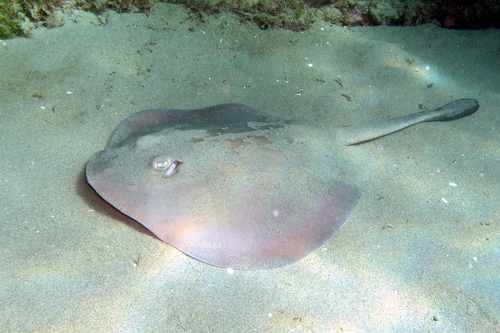
Eastern Shovelnose Stingaree
Trygonoptera imitata
A master of camouflage in the sandy shallows, the Eastern Shovelnose Stingaree is one of southeastern Australia's most common and fascinating coastal residents. With its broad, chocolate-brown disc and gentle gliding motion, it is a favorite for backyard beach observers and underwater photographers alike.
Quick Identification
Size
Total length up to 80 cm (31 in); disc width typically 40-50 cm (16-20 in).
Colors
Uniform light to dark chocolate brown on the upper side, occasionally with faint lighter or darker speckles; underside is off-white with darker disc margins.
Key Features
- Broad, rounded pectoral fin disc that is wider than it is long
- Fleshy snout forming a distinct obtuse angle
- Short tail ending in a well-developed leaf-shaped caudal fin
- Fringed skin curtain between nostrils with a strongly trailing margin
When You’ll See Them
Geographic range
Where Does the Eastern Shovelnose Stingaree Live?
The Eastern Shovelnose Stingaree is native to the temperate waters of the Oceania region. It is strictly endemic to the coastal shelf of southeastern Australia, with its core range extending from southern New South Wales down to eastern Victoria. While common along the mainland coast, it is notably absent from the waters of Tasmania, preferring the slightly warmer temperate zones of the mainland's southern reaches.
Basemap © OpenStreetMap contributors
Behavior
The Eastern Shovelnose Stingaree is a bottom-dwelling specialist, spending a significant portion of its life partially submerged in sandy or silty substrates. By using its pectoral fins to stir up the seafloor, it creates a shallow depression where it can hide from larger predators like sharks. While they are generally solitary, they are frequently seen in high densities in productive estuaries, especially during the warmer months when they move into shallower water to feed or breed.
Despite possessing a venomous spine on their tail for defense, these rays are remarkably docile and will almost always choose flight over fight. They glide with a rhythmic, undulating motion of their large pectoral fins, a movement that is both efficient and incredibly graceful. When approached by humans in the water, they tend to remain still, relying on their camouflage until the very last moment before darting away in a cloud of sand.
EverydayEarth exclusive
Camera Tips
To capture high-quality footage of the Eastern Shovelnose Stingaree, you need to deploy an underwater camera system—such as a GoPro in a waterproof housing or a specialized marine trail cam—in shallow, sandy-bottomed areas. Look for "halos" in the sand or patches near seagrass beds, which are prime foraging spots. Because these rays are benthic, the camera should be mounted as low as possible, ideally fixed to a weighted base plate or a low-profile tripod to keep it steady against the surge of the tide.
Baiting is highly effective for drawing these shy rays into your camera's field of view. Use a small, perforated PVC tube or a mesh bag filled with crushed oily fish, like sardines or pilchards, and stake it about 1 to 2 meters directly in front of the lens. The scent trail will attract the stingaree, and you'll likely capture fascinating footage of them using their "shovelnose" to investigate the source of the smell or even "tenting" their fins over the bait to protect it from other fish.
Lighting is your biggest challenge underwater. For the best natural color, aim for midday deployments when the sun is directly overhead, or use a camera with a red filter if you are submerged deeper than 5 meters. If you are using motion-activation, set the sensitivity to high; the ray’s movement can be very subtle as it glides just millimeters above the sand. A wide-angle lens is essential to capture the full span of their wide pectoral disc as they pass over the camera.
Similar Species
Species that look similar or are commonly confused with Eastern Shovelnose Stingaree.
Frequently Asked Questions
Record Eastern Shovelnose Stingaree at your habitat
Connect a camera to start building your own species record — AI identifies every visitor automatically.