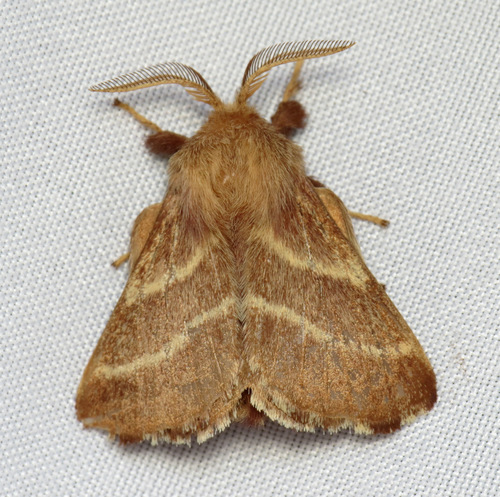
Eastern Tent Caterpillar Moth
Malacosoma americana
From intricate silk fortresses to vibrant fuzzy crawlers, the Eastern Tent Caterpillar Moth is a spring icon. Discover how these social architects transform your backyard trees into a hub of insect activity.
Quick Identification
Size
Caterpillars grow to 5 cm (2 in); adult moths have a wingspan of 2.5–5 cm (1–2 in)
Colors
Caterpillars are black with a white dorsal stripe and blue/orange markings; adult moths are reddish-brown with two diagonal white lines on the forewings
Key Features
- White silk 'tents' constructed in the crotches of tree branches
- Continuous white stripe down the caterpillar's back
- Moths have two distinctive pale diagonal lines on wings
- Hairy, stocky body in both larval and adult stages
When You’ll See Them
Geographic range
Where Does the Eastern Tent Caterpillar Moth Live?
The Eastern Tent Caterpillar Moth is native to North America, flourishing across a massive territory that spans from southern Canada down to the Gulf of Mexico. It is most prevalent throughout the eastern United States, stretching as far west as the Rocky Mountains, where it thrives in both rural woodlands and developed residential areas. Because its primary host trees like wild cherry and apple are so widespread, this species is a common sight in nearly every backyard from the Atlantic coast to the Great Plains.
Basemap © OpenStreetMap contributors
Behavior
Eastern Tent Caterpillars are highly social insects known for their communal silk nests. These 'tents' act as a home base and a solar heater, helping the larvae regulate their temperature during the cool early spring. The caterpillars emerge from the tent several times a day to feed on the foliage of their host tree, often following silk trails laid down by their siblings to find the best leaves.
As they mature, the caterpillars leave the tree to find a protected spot to spin a cocoon and pupate. The adult moths that emerge are nocturnal and live only for a few days—long enough to mate and for the females to lay a single mass of eggs on a branch. Unlike many other moths, the adults do not eat at all, having no functional mouthparts, and are frequently drawn to porch lights during the early summer.
EverydayEarth exclusive
Camera Tips
To capture the fascinating lifecycle of the Eastern Tent Caterpillar, position your camera near a 'tent' in the crotch of a cherry or apple tree during early spring. Because these nests are stationary, you can set up a tripod for a stable, close-up view. Use a time-lapse setting to document the growth of the silk structure over several weeks, which provides a mesmerizing look at insect architecture.
For the best action shots of the caterpillars, aim your lens at the main 'highway' branches leading away from the tent. They typically move in queues to feed three times a day: once in the morning, once in the afternoon, and once after sunset. Using a camera with a high-quality macro lens and a fast trigger speed will help capture the fine detail of their colorful, hairy bodies as they march toward their next meal.
If you are looking to photograph the adult moths, use a light-trap method. Moths are highly attracted to ultraviolet (UV) light. Placing a white sheet behind a blacklight and setting your camera to a motion-detect or 'timelapse-at-night' mode will result in excellent photos of the cinnamon-colored adults. Since the moths are short-lived, the window for these shots is usually a brief two-week period in mid-summer.
Consider the temperature when setting your camera. Eastern Tent Caterpillars are sun-seekers; on chilly spring mornings, you'll find them huddled on the surface of the tent to soak up the sun. Position your camera on the south-facing side of the nest to take advantage of the best natural lighting and the caterpillars' preference for warmth.
Similar Species
Species that look similar or are commonly confused with Eastern Tent Caterpillar Moth.
Frequently Asked Questions
Record Eastern Tent Caterpillar Moth at your habitat
Connect a camera to start building your own species record — AI identifies every visitor automatically.