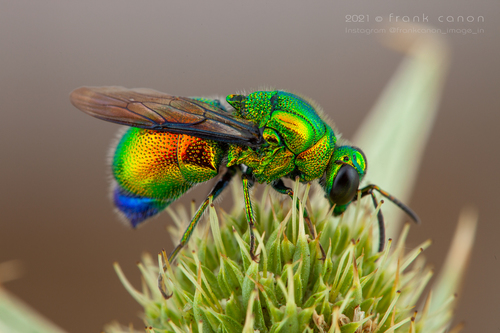
Emerald Cuckoo Wasp
Stilbum cyanurum
Often called the 'Living Jewel,' the Emerald Cuckoo Wasp is a master of iridescence and a clever nest-invader. Watch for its shimmering green armor as it patrols garden walls on the hunt for its next target.
Quick Identification
Size
10–20 mm (0.4–0.8 inches) in length
Colors
Brilliant iridescent emerald green, metallic blue, or deep violet; colors shift depending on the light angle
Key Features
- Large size for a cuckoo wasp, up to 20mm
- Striking metallic jewel-toned exoskeleton
- Hard, deeply pitted texture across the body
- Abdomen concave underneath for protection
- Moves with rapid, jerky flight patterns
When You’ll See Them
Geographic range
Where Does the Emerald Cuckoo Wasp Live?
This magnificent insect is a quintessential Old World species, boasting a massive range that begins in southern Europe and extends across the entire African continent. It is a common sight throughout much of Asia, including the Middle East, India, and Southeast Asia, and has established a strong presence across Australia. Because it follows the distribution of its host wasps, it is highly adaptable and can be found in almost any environment from Mediterranean coastlines to tropical urban gardens.
Basemap © OpenStreetMap contributors
Behavior
The Emerald Cuckoo Wasp is a fascinating cleptoparasite, meaning it lives a life of deception. Unlike social wasps, these are solitary creatures that do not build their own nests. Instead, they seek out the mud nests of other wasps, such as mud-daubers or potter wasps. Once a host's nest is located, the female uses her specialized, needle-like ovipositor to drill through the hard mud and deposit her egg inside the host's cell.
Despite their somewhat aggressive-sounding lifestyle, they are harmless to humans and lack a functional sting for defense. To protect themselves from the rightful owners of the nests they infiltrate, they have evolved an incredibly thick, armored exoskeleton. If attacked by a host wasp, the Emerald Cuckoo Wasp simply rolls into a tight, impenetrable ball, tucking its legs and antennae into specialized grooves until the danger passes.
Adults are frequently seen in sunny spots, particularly on old stone walls, wooden fences, or brickwork where their hosts might be nesting. They are highly active and alert, often appearing to 'dance' or hover nervously as they scan surfaces for the scent of a host's nest. While the larvae are carnivorous, the adults spend their time visiting flowers for nectar.
EverydayEarth exclusive
Camera Tips
To capture the Emerald Cuckoo Wasp, you need to think like a parasite. Look for the mud nests of Sceliphron (mud-daubers) or Eumenes (potter wasps) on the exterior walls of your house, shed, or under porch eaves. Mount your camera approximately 12 to 24 inches away from these nests. Because these wasps are small and move quickly, a camera with a high-speed trigger and macro-focusing capability is essential.
Lighting is the most important factor for getting a 'hero shot' of this species. The metallic colors of the exoskeleton only truly 'pop' when hit by direct sunlight. Position your camera on a wall that receives full morning or midday sun. The iridescent greens and blues will reflect beautifully, making the insect much easier to identify in your footage.
If you don't have mud nests nearby, you can lure them to a specific spot by planting 'pollinator magnets.' They are particularly attracted to flat-topped flower clusters like fennel, dill, wild carrot, and yarrow. Set your camera on a tripod at flower height during the hottest part of the day. Using a high frame rate (60fps or higher) will help you catch their jerky, rapid flight movements without too much motion blur.
Lastly, consider a 'bee hotel' or a 'bug bar' as a focal point. While these wasps don't nest in the holes themselves, they often patrol these areas looking for other solitary bees and wasps to parasitize. A shallow water dish with stones for landing can also be a great draw during peak summer heat, providing a stationary moment for a clear photo.
Frequently Asked Questions
Record Emerald Cuckoo Wasp at your habitat
Connect a camera to start building your own species record — AI identifies every visitor automatically.