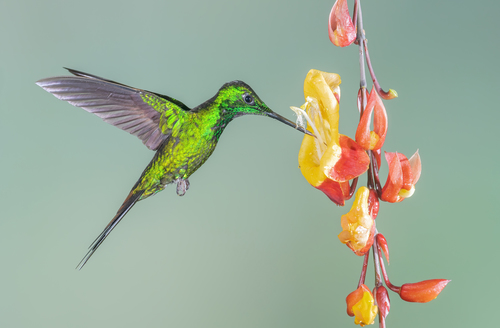
Empress Brilliant
Heliodoxa imperatrix
A crown jewel of the Andean cloud forests, the Empress Brilliant is a large, striking hummingbird known for its shimmering emerald feathers and exceptionally long tail. Experience the regal elegance of one of the Chocó region's most spectacular aerial acrobats.
Quick Identification
Size
15–17 cm (5.9–6.7 in) in length; weight roughly 8–9 g (0.28–0.32 oz)
Colors
Males are dark metallic green with a glittering golden-green or violet throat and a long, dark forked tail. Females are bronzy-green above with white, green-spotted underparts.
Key Features
- Exceptionally long, deeply forked tail in males
- Glittering golden-green throat gorget
- Large body size for a hummingbird
- Clings to flowers while feeding
When You’ll See Them
Geographic range
Where Does the Empress Brilliant Live?
This stunning hummingbird is a specialty of the South American Chocó region, a biodiversity hotspot. Its native range is concentrated along the western slopes of the Andes, stretching from western Colombia through northwestern Ecuador. Within this narrow emerald corridor, the Empress Brilliant thrives in the mist-shrouded cloud forests where humidity remains high year-round.
Basemap © OpenStreetMap contributors
Behavior
The Empress Brilliant is a high-energy "trap-liner," a foraging strategy where the bird follows a consistent, repeatable circuit through the forest to visit the same nectar-producing flowers daily. Unlike some territorial hummingbirds that aggressively guard a single patch of flowers, the Empress moves swiftly between locations, though it is still assertive enough to hold its own at a crowded feeder.
Interestingly, this species often prefers to perch while feeding rather than hovering exclusively. This conservation of energy allows it to navigate the steep, humid slopes of its Andean home. While generally solitary, they are frequently seen in the mid-story and canopy of the forest, occasionally descending to lower levels where garden flowers or feeders are available. Their flight is direct and powerful, making a distinct humming sound that experienced birders can recognize before the bird is even seen.
EverydayEarth exclusive
Camera Tips
To capture the Empress Brilliant's iridescent plumage, camera placement is the most critical factor. Position your AI-powered camera at a height of 5 to 7 feet, ideally near red or orange tubular flowers like Heliconias or fuchsias. Because this species is a "trap-liner," consistency is key; once they identify your yard as a reliable nectar source, they will return at roughly the same times each day. Angle the camera so it catches the morning or afternoon sun from behind the lens—this lighting is essential to reveal the "brilliant" golden-green gorget that otherwise looks dark or black in the shade.
Using a high-speed shutter setting is recommended to freeze the wing motion, though many AI cameras handle this automatically through their bird-detection modes. If using a feeder, choose one with a sturdy perch. Unlike smaller hummingbirds that hover constantly, the Empress Brilliant often prefers to land while drinking, providing a much more stable and clear image for the camera's sensor to identify and record.
Set your "activity zones" specifically around the feeder port or the most vibrant flower cluster to avoid false triggers from swaying branches. Because these birds are fast and can be shy, avoid placing the camera in high-traffic human areas. A quiet corner of a garden near a forest edge is the perfect "studio" for this Andean gem. During the rainy season, ensure your lens is protected with a small hood, as the Empress Brilliant remains active even in the mist, and a clear lens will make the difference between a blurry shape and a high-definition trophy shot.
Similar Species
Species that look similar or are commonly confused with Empress Brilliant.
Frequently Asked Questions
Record Empress Brilliant at your habitat
Connect a camera to start building your own species record — AI identifies every visitor automatically.