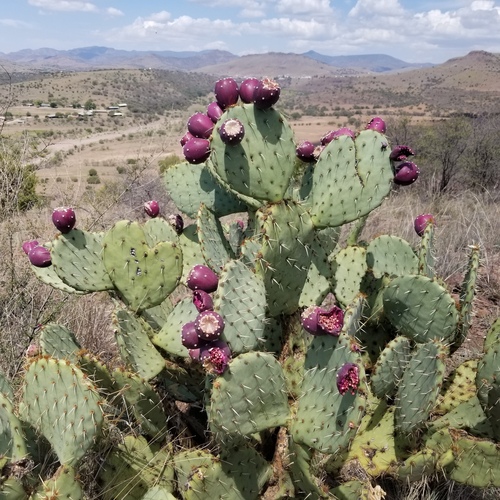
Engelmann's Pricklypear
Opuntia engelmannii
A legendary survivor of the American deserts, Engelmann's Pricklypear is much more than just a cactus. Its striking yellow blooms and succulent purple fruit make it a premier destination for backyard wildlife, from hummingbirds to javelinas.
Quick Identification
Size
Height up to 1.5–2 meters (5–6.5 feet); individual pads 15–30 cm (6–12 inches) long
Colors
Blue-green to dull green pads; bright yellow flowers (sometimes with red centers); deep reddish-purple or magenta fruit
Key Features
- Large, flat, oval or rounded pads
- Long, thick spines (1–5 per cluster) usually white or tan
- Large yellow bowl-shaped flowers that turn orange with age
- Fleshy, spineless purple fruit (tunas) when ripe
- Low-branching, sprawling growth habit
When You’ll See Them
Geographic range
Where Does the Engelmann's Pricklypear Live?
Native to the North American continent, Engelmann's Pricklypear is a defining feature of the Southwestern United States and Northern Mexico. Its core range spans from the dry regions of California and Arizona through New Mexico and Texas, extending southward into the Mexican states of Sonora, Chihuahua, and Coahuila. It is highly adaptable and frequently seen in suburban xeriscapes and rural desert borders throughout the Sunbelt region.
Basemap © OpenStreetMap contributors
Behavior
The Engelmann's Pricklypear is a slow-growing but hardy succulent that serves as a cornerstone of desert ecology. It grows in dense, sprawling thickets that provide essential cover for small mammals, reptiles, and birds. During the spring, the cactus undergoes a dramatic transformation, producing large, waxy flowers that are a primary nectar source for native bees and cactus-specialist insects.
As summer progresses, the plant develops 'tunas,' or prickly pear fruits. These fruits are highly sought after by wildlife, creating a focal point for animal activity. Humans have a long history with this species as well, utilizing the young pads (nopalitos) and the sweet fruit for food. In a backyard setting, it acts as a natural barrier and a reliable food source for local fauna, requiring almost no maintenance once established.
EverydayEarth exclusive
Camera Tips
Capturing the Engelmann's Pricklypear on camera is less about the plant itself and more about the incredible 'wildlife theater' it hosts. To see the most action, position your camera at a low angle, roughly 12 to 18 inches off the ground, pointing toward a cluster of ripe fruit (tunas) during the late summer. This will capture heavy hitters like javelinas, desert tortoises, and coyotes who come to feast on the fallen fruit.
For those interested in winged visitors, mount your camera on a stake or nearby post about 3 to 4 feet high, angled slightly downward toward the flowers. This is the best way to record the diversity of pollinators, including hummingbirds and various native bees, during the spring bloom. Because these flowers only open for a few hours a day, use a time-lapse setting or a high-sensitivity trigger to catch the rapid movement of insects. Since the plant doesn't move, you can set a slower shutter speed for beautiful, crisp images of the stationary pads against the moving desert background.
If you are using an AI-powered camera, ensure the 'Pet' or 'Small Animal' detection is enabled, as many of the cactus's most frequent visitors are ground squirrels, packrats, and rabbits that use the pads for both hydration and protection. Avoid placing the camera too close to the spines, as wind-blown movement of nearby grass can sometimes trigger false positives; a distance of 4 to 6 feet is usually the 'sweet spot' for a clear field of view without interference. Night vision is essential here, as many mammals visit the cactus under the cover of darkness to avoid the desert heat.
Frequently Asked Questions
Record Engelmann's Pricklypear at your habitat
Connect a camera to start building your own species record — AI identifies every visitor automatically.