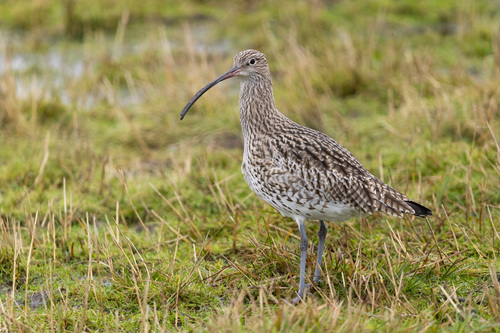
Eurasian Curlew
Numenius arquata
The Eurasian Curlew is the undisputed monarch of the marshlands, instantly recognizable by its elegant, scimitar-shaped bill and its wild, bubbling cry. As Europe's largest wading bird, it serves as a sentinel of our wetlands, bridging the gap between the rugged uplands and the shifting tides of the coast.
Quick Identification
Size
Length: 50–60 cm (20–24 in); Wingspan: 80–100 cm (31–39 in); Weight: 410–1,360 g (0.9–3.0 lb)
Colors
Mottled grayish-brown and buff with dark streaks; distinct white rump and lower back visible in flight; long, dark, down-curved bill with a pinkish base on the lower mandible.
Key Features
- Exceptionally long, downward-curving bill (up to 19cm)
- Large, streaked brown body with a bright white rump patch
- Long, slender blue-grey legs
- Evocative, bubbling 'cur-lee' vocalization
When You’ll See Them
Geographic range
Where Does the Eurasian Curlew Live?
The Eurasian Curlew is native to the vast temperate and subarctic regions of Europe and Asia. Its breeding range stretches from the British Isles and Scandinavia across Russia to the steppes of Central Asia and Northern China. During the winter months, these birds migrate to the milder Atlantic coasts of Europe, the Mediterranean basin, and as far south as the shorelines of Africa and Southern Asia. While they are a quintessentially wild species, they are increasingly found in lowland wet meadows and coastal agricultural fields near human settlements.
Basemap © OpenStreetMap contributors
Behavior
The Eurasian Curlew is a highly social bird outside of the breeding season, often forming large, vocal flocks on coastal mudflats and estuaries. They are famous for their haunting, melodic 'bubbling' call, which is one of the most iconic sounds of the British and European countryside. During the breeding season, they become more territorial, performing elaborate aerial displays to defend their nesting sites in damp moorlands and grasslands.
When foraging, the Curlew is a master of the 'probe and pull' technique. Its sensitive bill allows it to detect prey deep underground without seeing it. While generally wary of humans and quick to sound a loud alarm call that alerts all other wildlife in the vicinity, they can become somewhat accustomed to predictable human presence in agricultural areas, provided they are not approached directly.
EverydayEarth exclusive
Camera Tips
To capture a Eurasian Curlew on camera, placement is everything. If you live near a coastal area or an inland wetland, position your camera at the very edge of the water or near 'soft' mud patches where you see probe holes. Because these birds have long legs and a tall profile, set your camera on a low tripod or mount it about 12 to 18 inches off the ground, angled slightly upward. This captures the impressive curve of the bill and the detail of their plumage against the sky or water.
Curlews are highly sensitive to movement and 'new' objects in their environment. If you are placing a trail camera in a field or on a marsh, use a camera with a high-quality camouflage housing and try to place it near a natural feature like a clump of rushes or a fence post to break up its silhouette. Since they are active during the day and night (often feeding by moonlight on the coast), ensure your camera has a 'no-glow' or 'low-glow' infrared flash to avoid spooking them during nocturnal foraging sessions.
Using bait is generally not recommended for Curlews as they prefer live, deep-buried prey. Instead, focus on 'bottleneck' locations. Look for narrow channels in saltmarshes or specific damp depressions in grazing fields where they congregate to feed. In the spring, they are very vocal; if your camera has a sound-triggering or high-quality video mode, you can capture their incredible bubbling song. Set a fast shutter speed if your camera allows, as their movements while probing can be jerky and quick, leading to motion blur in low light.
Similar Species
Species that look similar or are commonly confused with Eurasian Curlew.
Frequently Asked Questions
Record Eurasian Curlew at your habitat
Connect a camera to start building your own species record — AI identifies every visitor automatically.