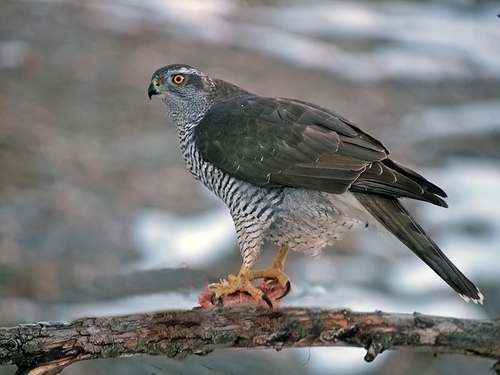
Eurasian Goshawk
Astur gentilis
The Eurasian Goshawk is the 'phantom of the forest,' a master of high-speed aerial maneuvers and stealthy ambushes. Discover how to track this powerful, red-eyed predator as it expands from deep woodlands into our backyard landscapes.
Quick Identification
Size
Length 48–69 cm (19–27 in); wingspan 88–127 cm (35–50 in); weight 0.5–2.2 kg (1.1–4.9 lbs)
Colors
Adults have slate-gray upperparts and white underparts with fine horizontal gray barring. They feature a dark cap and a prominent white 'eyebrow' (supercilium), with eyes that turn from yellow to deep orange or red with age.
Key Features
- Prominent white eyebrow stripe (supercilium) against a dark cap
- Broad, rounded wings and a long, wedge-shaped tail
- Fluffy white undertail coverts often visible during flight displays
When You’ll See Them
Geographic range
Where Does the Eurasian Goshawk Live?
The Eurasian Goshawk is native to the vast temperate and boreal regions of Eurasia, stretching from the United Kingdom and Western Europe across the Russian taiga to China and Japan. They are core residents throughout Central and Northern Europe, while populations in the furthest northern reaches of Scandinavia and Siberia may move south during the winter. While they are not found in North America (those populations are now considered the American Goshawk), they remain the dominant forest raptor across the Palearctic realm.
Basemap © OpenStreetMap contributors
Behavior
The Eurasian Goshawk is often called the 'phantom of the forest' due to its secretive nature and incredible ability to vanish into dense foliage. Unlike many other hawks that soar in the open sky, the goshawk is a forest specialist, using its short, powerful wings and long tail to weave through branches at high speeds. They are solitary and highly territorial, particularly during the breeding season when they will fiercely defend their nest against much larger intruders, including humans.
In the wild, they spend much of their time perched quietly on a hidden branch, watching for movement before launching a short, explosive ambush. While they were once strictly deep-forest birds, they have become increasingly bold in recent years, colonizing large urban parks and suburban woodlots where prey like pigeons and squirrels are plentiful. They are generally quiet birds, but during the spring, they perform spectacular 'sky-dance' displays and emit high-pitched 'kak-kak-kak' calls near their nesting sites.
EverydayEarth exclusive
Camera Tips
Capturing a Eurasian Goshawk on camera requires a strategic approach because they rarely spend time on the ground unless they are bathing or protecting a kill. To increase your chances, place your camera 5 to 10 feet high on a tree trunk, angled toward a sturdy, horizontal 'plucking branch'—a specific spot where the hawk brings its prey to remove feathers or fur. Look for areas with a concentration of bird feathers on the ground as a clue to these locations.
Water is one of the best ways to lure a goshawk into frame. They are fastidious bathers, especially after a meal. If you have a large, sturdy bird bath or a natural forest pool, position your camera low to the water's edge with a wide-angle lens. Because goshawks move with incredible speed, ensure your camera is set to its fastest trigger speed (0.2 seconds or less) and use 'Burst Mode' or 'Photo + Video' to capture the explosive motion of their flight.
Timing is everything. These birds are most active in the early morning and late afternoon. If you are monitoring a backyard or garden, late winter and early spring are the best times to see them as they become more vocal and active while establishing territories. During this time, they may be attracted to the high activity levels of smaller birds at your feeders, though they are there for the birds, not the seeds. Keep your camera focused on the perimeter trees where they like to stage their attacks.
Finally, consider the lighting. Goshawks are masters of camouflage, and their gray-and-white barred undersides can wash out in direct, harsh sunlight. If possible, face your camera North or South to avoid lens flare and capture the rich detail of their plumage in the soft, dappled light of the forest canopy. Avoid using high-glow infrared flashes if possible, as these intelligent birds can sometimes be spooked by the faint red glow; a 'No-Glow' or black IR flash is preferable for a completely stealthy setup.
Similar Species
Species that look similar or are commonly confused with Eurasian Goshawk.
Frequently Asked Questions
Record Eurasian Goshawk at your habitat
Connect a camera to start building your own species record — AI identifies every visitor automatically.