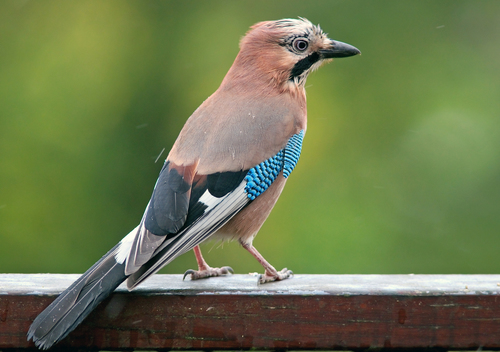
Eurasian Jay
Garrulus glandarius
With its signature electric blue wing patches and raspy call, the Eurasian Jay is the most colorful member of the crow family. A master of mimicry and a tireless planter of oak forests, this intelligent bird is a prize for any backyard wildlife enthusiast.
Quick Identification
Size
Length: 34–35 cm (13–14 in); Wingspan: 52–58 cm (20–23 in); Weight: 140–190 g (5–7 oz)
Colors
Pinkish-brown or fawn body, white throat and rump, black tail, and a signature patch of electric blue feathers with fine black barring on the wings.
Key Features
- Striking electric blue wing patch with black bars
- White rump highly visible during flight
- Thick black 'mustache' stripe (malar stripe) on a pale throat
- Raised crown feathers forming a subtle, speckled crest
When You’ll See Them
Geographic range
Where Does the Eurasian Jay Live?
The Eurasian Jay is native across a massive geographical expanse, originating in the temperate regions of Europe and North Africa before stretching across the Russian taiga all the way to the eastern seaboard of Asia and Japan. It is a common resident throughout the United Kingdom, Central Europe, and the Mediterranean, with various subspecies adapted to the diverse climates of the Himalayas and Southeast Asia. While mostly sedentary, northern populations may erupt and move southward in years when acorn crops fail, making them an exciting occasional visitor in areas where they aren't usually seen.
Basemap © OpenStreetMap contributors
Behavior
In addition to their own raucous calls, Eurasian Jays are expert mimics. They are frequently heard imitating the cries of Sparrowhawks or Buzzards to scare other birds away from food sources, and in suburban settings, they have been known to mimic garden machinery or even human whistling. They are generally solitary or found in pairs, but they may gather in small, noisy groups during 'jay marriages'—social gatherings where they choose mates and establish hierarchies.
EverydayEarth exclusive
Camera Tips
To capture the elusive Eurasian Jay, position your camera near the base of an oak or beech tree where they frequently forage for fallen nuts. They are cautious birds that rarely stay in one spot for long, so set your camera to its fastest trigger speed (ideally 0.2s to 0.5s) to catch them as they land. A camera height of 2 to 3 feet, angled slightly downward toward a clearing in the leaf litter, is perfect for capturing their ground-hopping behavior.
The best way to lure a Jay into your camera's frame is by providing a pile of whole, unsalted peanuts or acorns. Scatter them on a mossy log or a flat stone to create a natural-looking scene for your photos. If you use a bird table, ensure the camera is positioned far enough back to capture their relatively wide wingspan, as they often swoop in and snatch food without fully landing. They are most active in the early morning, so try to face your camera north or south to avoid the harsh glare of the rising sun.
During the autumn months, Jays become much bolder as they obsessively cache food for the winter. This is the prime time for photography. If your camera supports a 'burst' or 'multi-shot' mode, enable it; Jays often exhibit fascinating behaviors like 'anting' (letting ants crawl on them to clean their feathers) or vigorous preening, which are best captured through a sequence of high-speed images.
Similar Species
Species that look similar or are commonly confused with Eurasian Jay.
Frequently Asked Questions
Record Eurasian Jay at your habitat
Connect a camera to start building your own species record — AI identifies every visitor automatically.