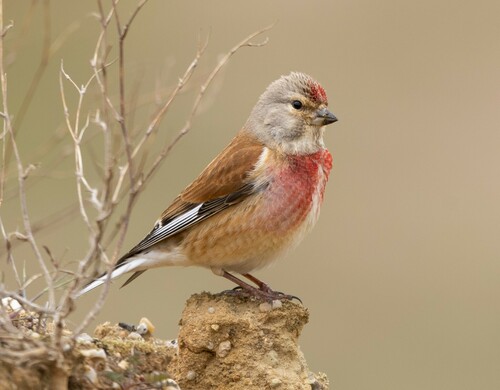
Eurasian Linnet
Linaria cannabina
A social finch with a song as bright as its plumage, the Eurasian Linnet is a delight of the open countryside. Watch for the male's crimson breast as they dance through wildflower meadows and garden edges.
Quick Identification
Size
Length 13-14 cm (5.1-5.5 in); Wingspan 21-25 cm (8.3-9.8 in); Weight 15-22 g (0.5-0.8 oz)
Colors
Males have a distinctive crimson-red forehead and breast during the breeding season, with a grey head and chestnut-brown back. Females and juveniles lack the red, appearing streaked with buff, brown, and grey.
Key Features
- Crimson forehead and breast on breeding males
- White edges on the primary wing feathers and tail
- Small, conical grey bill
- Slender build with a notched tail
When You’ll See Them
Geographic range
Where Does the Eurasian Linnet Live?
The Eurasian Linnet is native to the Palearctic region, spanning nearly all of Europe, North Africa, and Western Asia. Its core range extends from the British Isles and the Iberian Peninsula across Central Europe to the Ural Mountains and south into the Middle East. While many populations in Western and Southern Europe are year-round residents, those breeding in the colder northern and eastern reaches of Russia and Scandinavia are migratory, heading toward the Mediterranean basin for the winter.
Basemap © OpenStreetMap contributors
Behavior
The Eurasian Linnet is a highly social and vocal finch, famous for its sweet, complex song consisting of musical trills and twitters. They are rarely seen alone, usually moving in small family groups during the summer and forming much larger, restless flocks during the winter months. Their flight is typically 'undulating' or bouncy, a common trait among finches, which they often accompany with a sharp 'teu-teu-teu' call.
These birds are primarily ground-feeders, spending much of their day hopping through short grass or stubble fields in search of seeds. Unlike some bolder garden birds, Linnets can be somewhat shy and easily spooked, preferring the safety of thick cover like gorse or hawthorn hedges. They have a fascinating history with humans; their name is derived from their love of flax seeds (from which linen is made), and they were once popular cage birds due to their beautiful singing voice.
EverydayEarth exclusive
Camera Tips
To capture the best footage of a Eurasian Linnet, you need to think like a ground-feeder. Place your camera very low—ideally between 10 and 20 centimeters (4-8 inches) off the ground—facing a patch of bare earth or very short grass where you have scattered seeds. Because they are cautious, position the camera near a 'staging post,' such as a low bush or a pile of brush, where the birds can perch and survey the area before dropping down to feed.
Baiting is highly effective for Linnets, but they have specific tastes. Standard large-seed mixes often go untouched; instead, use a specialized 'finch mix' containing niger seeds, hemp, or crushed sunflower hearts. If you can find flax seeds (linseed), these are a natural magnet for the species. Scatter the seeds widely rather than in a single pile to encourage the birds to stay within the camera's field of view for longer as they forage.
Water is an underrated lure for this species. A shallow, ground-level birdbath with a rough bottom for grip will attract Linnets for both drinking and social bathing. Since they often visit in small groups, set your AI camera to a wide-angle setting if possible to capture the social dynamics. The best lighting occurs in the early morning; ensure your camera is positioned so the sun is behind it, highlighting the vibrant crimson breast of the males during the spring and summer months.
Similar Species
Species that look similar or are commonly confused with Eurasian Linnet.
Frequently Asked Questions
Record Eurasian Linnet at your habitat
Connect a camera to start building your own species record — AI identifies every visitor automatically.