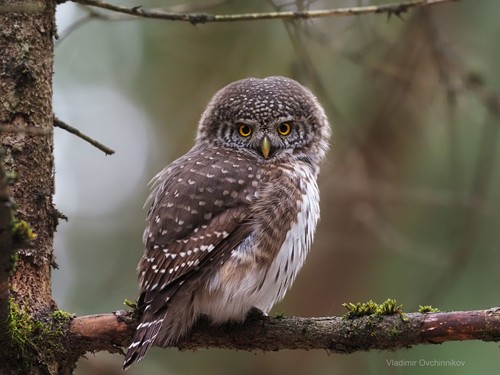
Eurasian Pygmy-Owl
Glaucidium passerinum
The Eurasian Pygmy-Owl may be small enough to fit in your palm, but it is a fierce and fearless hunter of the northern forests. With its striking yellow eyes and 'false face' plumage, this diurnal owl is a favorite for backyard birders and forest explorers alike.
Quick Identification
Size
Length: 15–19 cm (5.9–7.5 in); Wingspan: 32–39 cm (12.6–15.4 in); Weight: 50–80 g (1.8–2.8 oz)
Colors
Dark reddish to greyish-brown upperparts with small white spots; white underparts with brown vertical streaks; yellow eyes and beak; distinct white 'false eyes' on the back of the head.
Key Features
- Diminutive size similar to a large sparrow
- Distinctive 'false face' pattern on the nape of the neck
- Small, flat-topped head without ear tufts
- Frequent cocking and flicking of the tail when perched
When You’ll See Them
Geographic range
Where Does the Eurasian Pygmy-Owl Live?
Native to the massive stretch of the Palearctic region, the Eurasian Pygmy-Owl lives throughout the boreal forest belt of Northern and Central Europe across to Siberia and Northern China. This hardy resident can be found from the Scandinavian Peninsula and the mountainous regions of Central Europe, like the Alps and Pyrenees, all the way to the Pacific coast of Russia. While it is primarily a bird of the deep forest, it is increasingly spotted in wooded suburban areas that border mature timberlands.
Basemap © OpenStreetMap contributors
Behavior
The Eurasian Pygmy-Owl is a bold and surprisingly aggressive predator despite being the smallest owl in Europe. Unlike many of its cousins, this species is primarily diurnal or crepuscular, meaning it is most active during daylight hours, particularly at dawn and dusk. They are solitary birds that maintain strict territories, often making their presence known through a repetitive, whistling song that can be heard from a great distance during the breeding season.
These owls are known for their 'sit-and-wait' hunting style, perched on high coniferous branches where they survey the ground for movement. A unique behavioral trait is their tendency to cache food; during the autumn and winter, they store dozens of small mammals and birds in tree cavities or abandoned woodpecker holes to ensure a steady food supply when hunting is difficult. While they generally avoid humans, they are remarkably fearless and may allow a close approach if they are focused on prey.
EverydayEarth exclusive
Camera Tips
To capture the Eurasian Pygmy-Owl on camera, focus your efforts on forest edges or clearings where coniferous trees meet open spaces. Because these owls are active during the day, you don't need to rely solely on infrared night vision; setting your camera to capture high-quality daytime triggers is essential. Look for 'plucking posts'—stumps or flat branches littered with feathers or fur—as these are favorite spots for the owl to process its prey. Mount your camera at a height of 2 to 3 meters, angled slightly downward toward these high-activity areas.
If you have a backyard bordering a forest, placing a camera near a bird feeder can be unexpectedly effective. While the owl won't eat seeds, it is highly attracted to the small songbirds that gather there. Avoid using artificial lures or calls, as this can stress the bird, but consider installing a nest box designed for small owls (with a 45mm entrance hole) in late winter. This is the most reliable way to get consistent, close-up footage during the spring nesting season.
Adjust your camera's sensitivity settings to high, as these birds move quickly and are very small, which can sometimes fail to trigger sluggish PIR sensors. Use a fast shutter speed or high-frame-rate video to capture their rapid flight and characteristic tail-flicking behavior. During the winter, check your camera near old woodpecker holes, as the owls often visit these 'pantries' to retrieve cached food during the day.
Similar Species
Species that look similar or are commonly confused with Eurasian Pygmy-Owl.
Frequently Asked Questions
Record Eurasian Pygmy-Owl at your habitat
Connect a camera to start building your own species record — AI identifies every visitor automatically.