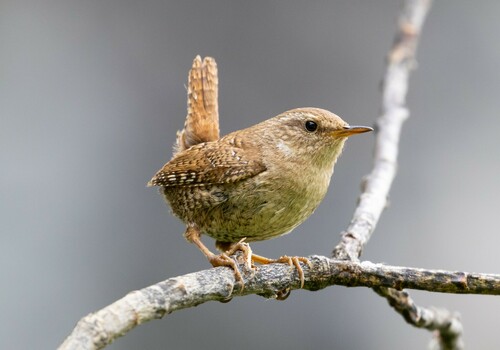
Eurasian Wren
Troglodytes troglodytes
The Eurasian Wren is a pocket-sized powerhouse, known for its remarkably loud song and its habit of scurrying through garden undergrowth like a tiny feathered mouse.
Quick Identification
Size
Length: 9–10.5 cm (3.5–4.1 in); Wingspan: 13–17 cm (5.1–6.7 in); Weight: 7–12 g (0.25–0.42 oz)
Colors
Rich russet-brown upperparts with dark barring on wings and tail; pale buff-brown underparts; distinct cream-colored stripe (supercilium) above the eye. Sexes are visually identical.
Key Features
- Short, stubby tail often cocked vertically
- Mouse-like movement through undergrowth
- Loud, melodic song with complex trills
- Fine, slightly decurved bill
When You’ll See Them
Geographic range
Where Does the Eurasian Wren Live?
Native to the vast stretches of Eurasia and the northern fringes of Africa, the Eurasian Wren is one of the most widely distributed birds in the Old World. Its core range spans from the British Isles and Western Europe through the temperate forests of Russia and Central Asia, reaching as far east as Japan and the Korean Peninsula. While largely a resident species in temperate zones, populations in the far north may move south to escape harsh winters, making it a familiar garden visitor across almost every corner of its massive range.
Basemap © OpenStreetMap contributors
Behavior
The Eurasian Wren is a tiny bird with an outsized personality. Known for its 'mouse-like' behavior, it is most often seen darting through dense vegetation or hopping along the ground in search of insects. Despite its small size, it is famously loud; its song is a remarkably powerful series of clear notes and trills that can be heard from a great distance. It is a highly territorial species, with males often building several 'cock nests' to impress a female, who will then choose one to line and use for eggs.
While they are solitary and fiercely defensive of their patch during the breeding season, Eurasian Wrens exhibit a fascinating social behavior during extreme cold. To conserve body heat, these tiny birds will huddle together in communal roosts, sometimes with dozens of individuals packed into a single nesting box or tree cavity. In human-centric environments, they are bold but cautious, frequently visiting gardens that offer plenty of 'messy' corners like log piles or overgrown ivy.
EverydayEarth exclusive
Camera Tips
To capture the Eurasian Wren on camera, you must think low to the ground. These birds rarely spend time in the high canopy, preferring to forage in the 'shadow zone' of your garden. Set your camera at a height of 30 to 60 centimeters (1 to 2 feet) and aim it toward a feature they find irresistible: a log pile, an old stone wall, or the base of a thick hedge. Because of their tiny size and rapid movements, use the highest sensitivity setting for your PIR sensor to ensure the camera triggers the moment they enter the frame.
Standard bird feeders are rarely successful for wrens, as they aren't big seed-eaters. Instead, try 'baiting' an area with live or dried mealworms scattered near a hollow log or inside a bug hotel. This encourages them to stay in the frame longer as they forage. If your camera has a macro or close-focus mode, use it; wrens are comfortable coming very close to equipment if it is well-camouflaged and doesn't move.
Water is a major draw for this species. A shallow, ground-level birdbath with a small solar fountain or dripper will often attract them for bathing and drinking. Ensure the camera is positioned to capture the water's surface. Because wrens move with a jittery, 'stop-start' motion, setting your camera to take a burst of 3-5 photos or a short high-frame-rate video will give you the best chance of getting a sharp, clear image of them with their iconic tail cocked.
Similar Species
Species that look similar or are commonly confused with Eurasian Wren.
Frequently Asked Questions
Record Eurasian Wren at your habitat
Connect a camera to start building your own species record — AI identifies every visitor automatically.