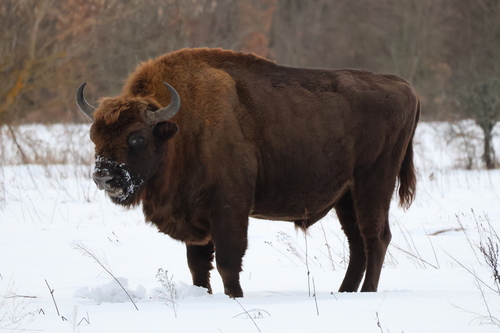
European Bison
Bison bonasus
The European Bison is the continent's heaviest land animal and a majestic survivor of the ice age. Once extinct in the wild, this 'King of the Forest' has made a legendary comeback through dedicated conservation efforts.
Quick Identification
Size
Length: 2.1–3.5 m (6.9–11.5 ft); Height: 1.6–1.9 m (5.2–6.2 ft); Weight: 400–920 kg (880–2,030 lb)
Colors
Dark to golden-brown coarse fur; thick, shaggy mane around the neck and forehead; dark brown beard
Key Features
- Prominent shoulder hump
- Short, thick horns curving slightly upward and inward
- Massive, shaggy head held lower than the shoulders
- Tapered hindquarters compared to a heavy, muscular front
When You’ll See Them
Geographic range
Where Does the European Bison Live?
Native to the European continent, the European Bison is a symbol of successful rewilding. While once widespread across the continent, its core populations are now found in the lowland forests and mountains of Poland and Belarus, most notably in the Białowieża Forest. Significant reintroduced populations also thrive in Russia, Romania, Ukraine, Germany, and Slovakia, where they occupy protected wilderness areas and national parks.
Basemap © OpenStreetMap contributors
Behavior
Unlike their American relatives who are famous for roaming open prairies, the European Bison is a forest-dweller. They spend much of their day alternating between foraging in clearings and ruminating in the shade of dense thickets. Their movements are slow and deliberate, but they are capable of surprising bursts of speed and can jump over obstacles that would stop most large livestock.
EverydayEarth exclusive
Camera Tips
When setting up a trail camera for European Bison, the most important consideration is the height and security of your equipment. Because these are massive animals, you should mount your camera approximately 1.2 to 1.5 meters (4–5 feet) high on a very sturdy, thick tree. Bison are known to use trees as scratching posts; if your camera isn't in a heavy-duty steel security box or attached with a thick cable lock, it may be inadvertently knocked off or damaged by a 900kg bull looking to scratch an itch.
Placement is key to capturing good footage. Focus on 'pinch points' where forest trails open into meadows or clearings. Bison frequent salt licks, which are often maintained by foresters in their range; these are excellent spots for high-traffic captures. Look for signs of their presence like large cloven tracks (significantly larger than deer or elk) and clumps of coarse brown hair caught on low-hanging branches or bark.
Use a wide-angle setting if your camera allows it. These animals are so large that they can easily fill the frame and appear as just a wall of brown fur if the camera is too close to the trail. Setting your camera to record short 15-20 second video clips is often better than still photos, as it captures the social dynamics of the herd and the slow, rhythmic way they move through the undergrowth.
During the winter months, bison are easier to track but move less to conserve energy. Their dark fur creates a stunning contrast against the white snow, making for professional-grade imagery. If your camera has a 'time-lapse' mode, consider using it near known winter feeding stations where they might congregate for hours at a time.
Similar Species
Species that look similar or are commonly confused with European Bison.
Frequently Asked Questions
Record European Bison at your habitat
Connect a camera to start building your own species record — AI identifies every visitor automatically.