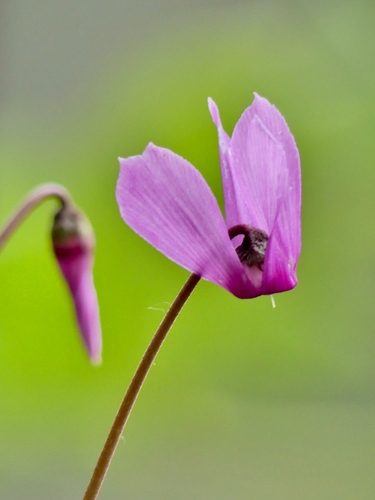
European Cyclamen
Cyclamen purpurascens
A fragrant jewel of the European woodlands, the European Cyclamen captivates with its uniquely swept-back petals and beautifully marbled evergreen foliage.
Quick Identification
Size
Height: 10–15 cm (4–6 in); Leaf width: 2–8 cm (0.8–3 in)
Colors
Deep carmine to pale pink flowers; dark green leaves with silvery-white marbling and reddish-purple undersides
Key Features
- Swept-back 'upside-down' pink petals
- Heart-shaped evergreen leaves with silver variegation
- Strong, sweet floral fragrance similar to lilies
- Flower stalks that coil into a spiral after pollination
- Reddish-purple coloration on the leaf undersides
When You’ll See Them
Geographic range
Where Does the European Cyclamen Live?
The European Cyclamen is primarily native to the central regions of the European continent, finding its stronghold in the limestone-rich soils of the Alps and the Jura Mountains. Its core range extends from the shadows of northern Italy and eastern France across Switzerland and Austria into the Balkan Peninsula, including Slovenia and Croatia. While it is primarily a mountain dweller, it has naturalized in several neighboring regions and remains a beloved, hardy resident of temperate woodland environments across the region.
Basemap © OpenStreetMap contributors
Behavior
The European Cyclamen is a long-lived perennial that grows from a subterranean tuber. Unlike many other cyclamen species that go dormant during the heat of summer, the European Cyclamen is evergreen, maintaining its beautifully patterned foliage throughout the year. It enters its most active reproductive phase in mid-to-late summer, sending up delicate flower stalks that provide a rare splash of color to the forest floor when most other woodland plants have finished blooming.
This species has a fascinating relationship with its environment, particularly regarding seed dispersal. Once the flowers are pollinated by bees or hoverflies, the flower stalk (pedicel) begins to coil tightly, pulling the developing seed pod toward the ground. The seeds are coated in a sticky, sugary substance called an elaiosome, which attracts ants. These ants carry the seeds to their nests, eat the elaiosome, and discard the seeds in nutrient-rich refuse piles, effectively 'planting' the next generation.
EverydayEarth exclusive
Camera Tips
Capturing the European Cyclamen on a trail camera requires a different strategy than tracking mobile wildlife. Because these plants are diminutive—reaching only about 15 centimeters in height—your camera must be positioned extremely low to the ground. Using a ground stake or a low-profile tripod is essential to get an eye-level view of the delicate, swept-back flowers. To truly appreciate their intricate patterns, aim for a 'macro' perspective; ensure you are mindful of your camera's minimum focus distance to avoid blurry images. Placing the camera about 2 to 3 feet away is typically the sweet spot for most AI-powered backyard units.
Timelapse mode is the secret weapon for documenting the European Cyclamen. Since the plant is stationary, standard motion-triggering will rarely activate unless a pollinator like a bumblebee or moth visits the flower. Set your camera to take an image every hour during the peak blooming months of July and August. This allows you to witness the fascinating life cycle of the plant, from the initial budding to the way the flower stalks dramatically coil into a tight spiral as the seeds develop. This coiling mechanism is a hallmark of the species and makes for a stunning visual sequence when viewed as a high-speed video.
Lighting is the final key to a professional-looking shot. Because these plants thrive in the deep shade of beech forests or garden corners, light can be dappled and inconsistent. Position your camera to face north or south to avoid the harsh 'hot spots' of direct east-west sunlight, which can overexpose the silver patterns on the leaves and wash out the deep pink of the petals. If you are monitoring a specimen in a backyard setting, the soft, indirect light of dawn or a slightly overcast day will best highlight the vibrant carmine colors and the velvety texture of the foliage.
Frequently Asked Questions
Record European Cyclamen at your habitat
Connect a camera to start building your own species record — AI identifies every visitor automatically.