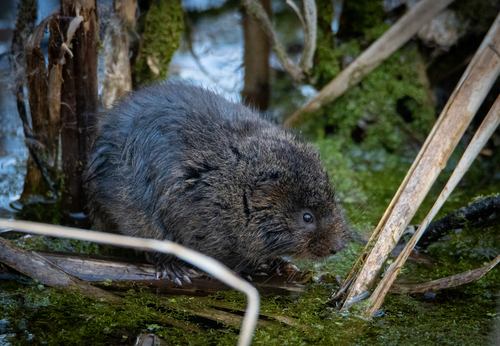
European Water Vole
Arvicola amphibius
Meet the charming architect of the riverbank, often mistaken for a rat but possessing a much gentler nature. Discover how to spot the European Water Vole, a semi-aquatic marvel that brings life to our wetlands.
Quick Identification
Size
Head-body length 14–22 cm (5.5–8.7 in); tail length 9.5–14 cm (3.7–5.5 in); weight 150–300g (5.3–10.6 oz)
Colors
Rich chestnut-brown to dark brown fur; pale grey or buff underside; small dark ears; furry tail
Key Features
- Blunt rounded muzzle with a 'chubby' face
- Small ears almost entirely hidden by thick fur
- Furry tail roughly half the length of the body
- Stocky, compact build with dark brown fur
When You’ll See Them
Geographic range
Where Does the European Water Vole Live?
Native to the vast temperate regions of Europe and Northern Asia, the European Water Vole's range stretches from the United Kingdom in the west across central Europe and into Russia and Siberia. In southern Europe, they are found as far as the Mediterranean coast, while their northern limits reach well into Scandinavia. While they are widespread across the Palearctic, local populations—particularly in the UK—have seen significant declines due to habitat loss and predation by invasive species.
Basemap © OpenStreetMap contributors
Behavior
European Water Voles are semi-aquatic specialists that live in complex burrow systems along the banks of slow-moving water. They are known for being relatively shy but can be observed during the day as they are not strictly nocturnal. They are excellent swimmers, though they lack the webbed feet found in some other aquatic mammals, relying instead on powerful strokes. One of the most characteristic signs of their presence is the distinct 'plop' sound they make when diving into the water from a bank to escape predators.
These rodents are largely solitary and territorial, especially during the breeding season. They mark their territories using scent glands and latrines—heaps of droppings often found on flat stones or prominent tufts of grass near the water's edge. While they generally avoid humans, they can become accustomed to quiet observers in gardens or parks that border suitable waterways, often returning to the same 'feeding stations' to eat.
EverydayEarth exclusive
Camera Tips
To capture these elusive 'water rats' on camera, focus on the 'water-margin'—the narrow strip of land where the bank meets the water. Look for 'feeding stations,' which are distinctive piles of neatly cut vegetation (usually 5-10cm long) left at a 45-degree angle. Placing your camera 6-10 inches off the ground, angled slightly downward toward these stations or a fresh latrine, is the most effective way to get a clear, eye-level shot.
Because they are active both day and night, use a camera with a fast trigger speed and high-quality infrared flash for crisp night shots without startling the animal. Positioning the camera near a burrow entrance—a hole in the bank usually located just above or below the water level—will guarantee sightings. Avoid placing cameras in areas with heavy reeds that might blow in the wind and trigger the sensor unnecessarily; try to clear a small 'window' in the vegetation if needed to ensure the sensor detects movement efficiently.
While they don't require traditional bait, you can entice them to linger in front of the lens by placing a few slices of apple or carrot near a known feeding station. The best time to film is during the spring and summer when they are most active and breeding. During winter, they spend more time underground or beneath the snow in colder regions, so focus your efforts during the warmer months for the best results. Ensure your camera is secured firmly, as soft riverbank soil can shift, causing your camera to lose its angle.
Similar Species
Species that look similar or are commonly confused with European Water Vole.
Brown Rat
Much larger, more prominent ears, a pointed muzzle, and a long, scaly, hairless tail.
Bank Vole
Significantly smaller and primarily terrestrial, found in woodland rather than exclusively near water.
Muskrat
Much larger than a water vole, with a vertically flattened tail used for swimming (found in North America and introduced in Europe).
Frequently Asked Questions
Record European Water Vole at your habitat
Connect a camera to start building your own species record — AI identifies every visitor automatically.