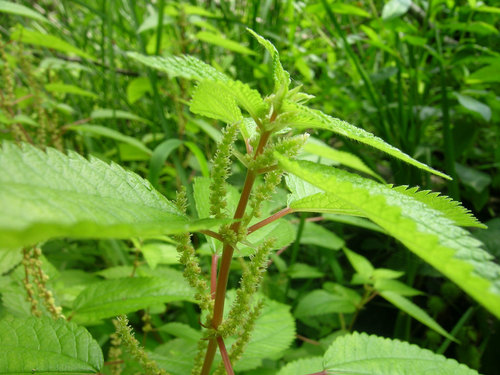
false nettle
Boehmeria cylindrica
The false nettle is a sting-free powerhouse for your backyard ecosystem. A favorite of Red Admiral butterflies, this lush green plant turns damp, shaded corners into a bustling nursery for local wildlife.
Quick Identification
Size
1.5 to 3 feet (45–90 cm) tall; leaves 3–6 inches (7.5–15 cm) long
Colors
Bright green to lime green foliage; greenish-white flower spikes; stems are translucent green
Key Features
- Complete lack of stinging hairs on stems and leaves
- Opposite, serrated, ovate leaves
- Prominent three-veined pattern on each leaf
- Upright, cylindrical greenish flower clusters growing from leaf axils
When You’ll See Them
Behavior
In the wild, its primary 'behavior' is acting as a host. It is a critical nursery plant for several species of butterflies, including the Red Admiral and the Question Mark. You will often observe the leaves being manipulated by caterpillars; they frequently roll the leaves into protective tubes or 'tents' secured with silk to hide from predators while they feed during the night.
EverydayEarth exclusive
Camera Tips
To successfully capture the activity around false nettle, you should treat the plant as a 'hub' rather than a single subject. Position your AI camera on a tripod or mount it to a nearby stake at a height of 12 to 18 inches. Angle the lens slightly downward to cover a cluster of leaves. Because the most interesting action involves small caterpillars and visiting butterflies, use a camera with a short focal length or a macro-enabled lens to ensure the AI can distinguish between a leaf and a Red Admiral caterpillar.
Since false nettle grows in damp, shaded areas, lighting is your biggest challenge. Avoid placing the camera where it will face the direct afternoon sun, which can cause harsh highlights on the waxy leaves. Instead, aim for a spot that receives dappled morning light. This soft lighting will help your camera’s sensor capture the translucent quality of the stems and the intricate textures of the 'tents' built by larvae. If your camera has adjustable motion sensitivity, turn it up; the movement of a caterpillar is subtle compared to a squirrel or bird.
For the best results, look for leaves that appear folded or stitched together. These are active nurseries. Focus your camera on these specific leaves. Over several days, you can capture a fascinating time-lapse of the larvae emerging to feed or the transformation of the plant as it produces its unique cylindrical flower spikes. These spikes are wind-pollinated, but they often attract small beneficial wasps and flies that the AI can track if the camera is positioned within 2-3 feet of the plant.
During the peak of summer (July and August), keep your camera running 24/7. While the butterflies are active during the day, the dense, moist foliage of a false nettle patch often attracts amphibians like tree frogs or American toads at night. They use the plant for cover and to hunt the insects attracted to the greenery. Use a low-glow infrared setting for night captures to avoid overexposing the green leaves, which can reflect IR light quite strongly.
Frequently Asked Questions
Record false nettle at your habitat
Connect a camera to start building your own species record — AI identifies every visitor automatically.