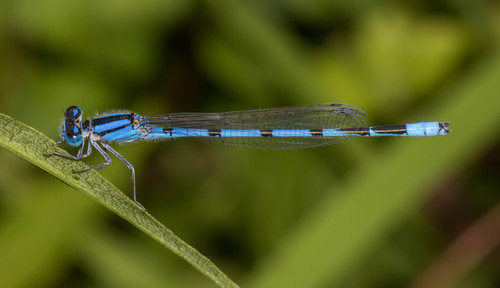
Familiar Bluet
Enallagma civile
Meet the Familiar Bluet, the sky-blue 'living jewel' of the North American wetlands. This energetic damselfly is a master of the air and a welcome visitor to any backyard pond or garden.
Quick Identification
Size
Length of 1.2 to 1.5 inches (30-38 mm); wingspan of approximately 1.5 to 1.8 inches (38-46 mm).
Colors
Males are vibrant sky blue with black rings; females are polymorphic, appearing either 'andromorph' (blue like males) or 'heteromorph' (tan, olive, or grey-green).
Key Features
- Bright sky-blue abdomen with small black rings
- Segment 8 and 9 of the abdomen are entirely blue in males
- Double-striped thorax with a wide black humeral stripe
- At rest, wings are held together vertically over the back
When You’ll See Them
Behavior
During the peak of the day, males are particularly visible as they defend small floating territories near the water's edge. Their flight is characterized by a bouncy, low-to-the-surface movement. When it comes to reproduction, they perform a unique 'tandem' flight where the male clasps the female behind the head. They often lay eggs (oviposition) together, with the male remaining attached to the female as she dips her abdomen into the water to place eggs on aquatic plants, protecting her from other males during the process.
EverydayEarth exclusive
Camera Tips
Capturing a Familiar Bluet on a backyard or trail camera requires a specialized setup due to their small size and specific habits. To get high-quality footage, you must identify their 'sentinel perches.' These are typically sun-drenched twigs, reeds, or blades of grass that extend over or near a water source. Familiar Bluets are creatures of habit and will often return to the exact same perch after a short hunting flight. Position your camera on a tripod or mount just 6 to 12 inches away from the tip of a likely perch. If your camera has a macro mode or a high-resolution sensor that allows for digital zooming without losing detail, this is the time to use it.
Lighting is the most critical factor for insect photography. These damselflies are most active in full sun, which also provides the best illumination for their iridescent blue bodies. Try to position your camera so the sun is at your back or slightly to the side to avoid silhouetting the insect. Early afternoon is prime time, but the 'golden hour' shortly before sunset can create spectacular effects by backlighting their transparent wings, making the delicate vein patterns visible. If you are using a trigger-based camera, ensure the sensitivity is set to its highest level, as the movement of a small damselfly may not trigger standard PIR sensors; a time-lapse mode set to 5-second intervals is often a more reliable way to 'catch' them.
Since these damselflies are sensitive to wind, choose a calm day for your session. On windy days, they tend to hide deep within thick vegetation where they are difficult to film. You can 'bait' an area for photography not with food, but with habitat. Placing a few clean bamboo stakes or decorative metal garden stakes in a sunny, sheltered spot near a pond will provide them with the perfect stage. Ensure the background is several feet away from the perch to create a beautiful 'bokeh' effect, which makes the vibrant blue of the Familiar Bluet stand out against a soft, blurred green backdrop.
Similar Species
Species that look similar or are commonly confused with Familiar Bluet.
Boreal Bluet
The Boreal Bluet has larger, mushroom-shaped black spots on its abdominal segments compared to the thin rings of the Familiar Bluet.
Tule Bluet
Tule Bluets have significantly more black on their abdomen, often making them look darker than the bright sky-blue Familiar Bluet.
Blue-fronted Dancer
Dancers hold their wings slightly higher and further back when perched, whereas the Familiar Bluet holds them tight and parallel to its body.
Frequently Asked Questions
Record Familiar Bluet at your habitat
Connect a camera to start building your own species record — AI identifies every visitor automatically.