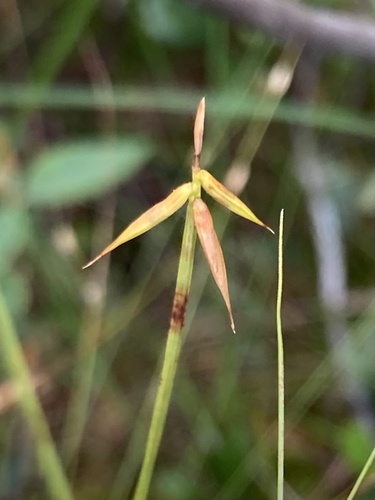
few-flowered sedge
Carex pauciflora
A delicate specialist of the northern peatlands, the few-flowered sedge is famous for its unique downward-pointing fruit. This slender, wiry plant is a hidden gem of the bog, rewarding patient observers with its elegant, minimalist structure.
Quick Identification
Size
Stems reach 5–40 cm (2–16 inches) in height; leaves are roughly 0.5–1.5 mm wide.
Colors
Light green stems and leaves; flowers and fruit transition from pale green to a straw-like yellowish-brown as they mature.
Key Features
- Single terminal spike containing 1-6 female flowers
- Reflexed (downward-pointing) perigynia at maturity
- Thin, wiry stems that are smooth and slightly stiff
When You’ll See Them
Behavior
The few-flowered sedge is a subtle but fascinating perennial that plays a vital role in the delicate ecosystems of northern bogs. Unlike many sedges that grow in dense clumps, this species typically emerges as solitary stems or small loose groups connected by slender, creeping underground rhizomes. This allows it to navigate the uneven surface of sphagnum moss mounds without competing too heavily with its neighbors.
Its most distinctive 'behavior' occurs during the fruiting stage in mid-to-late summer. As the seeds (perigynia) mature, they pivot from an upright position to a sharply reflexed, downward-pointing angle. This unique physical change is thought to aid in seed dispersal, as the seeds can easily detach and fall into the moist moss or be carried away by passing water or small bog-dwelling animals. While it doesn't move like the animals usually captured on trail cameras, its seasonal transformation is a slow-motion marvel of botanical engineering.
EverydayEarth exclusive
Camera Tips
Capturing high-quality images of the few-flowered sedge with a trail camera requires a different approach than tracking mobile wildlife. Because this plant is small and slender, you should mount your camera on a ground-level stake or a dedicated low-profile tripod. Position the lens approximately 6 to 10 inches from the ground to capture the detail of the terminal spike. If your AI-powered camera has a macro or 'close-focus' setting, ensure it is enabled to prevent the background sphagnum from stealing the focus.
Standard motion triggers may not activate for a stationary plant, so the best way to monitor this species is by using a Time-Lapse mode. Set your camera to take a photo every 4 to 6 hours during the peak growing months of June through August. This will allow you to document the fascinating transition of the seed heads as they pivot from an upward-facing position to their signature downward-pointing 'reflexed' state. This botanical movement is a great way to test the sensitivity and clarity of your camera setup.
Lighting is a major challenge in bog environments where glare from water can wash out details. Try to angle your camera facing North or South to avoid direct lens flare from the rising or setting sun. If the area is particularly windy, use a higher shutter speed setting if available; the wiry stems of the few-flowered sedge are prone to swaying, which can cause motion blur in lower-light conditions. Placing a small, neutral-colored background card behind the plant can also help your AI camera's autofocus lock onto the thin stems rather than the complex moss textures behind it.
Frequently Asked Questions
Record few-flowered sedge at your habitat
Connect a camera to start building your own species record — AI identifies every visitor automatically.