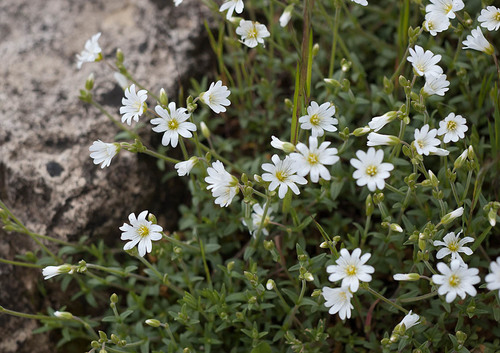
field chickweed
Cerastium arvense
Adorning meadows and rocky edges with delicate white stars, field chickweed is a hardy native beauty that signals the true arrival of spring. Often called field mouse-ear for its fuzzy leaves, this low-growing perennial is a favorite for early-season pollinators and backyard photographers alike.
Quick Identification
Size
Grows 5–30 cm (2–12 inches) tall; flowers are roughly 1–2 cm (0.4–0.8 inches) in diameter.
Colors
Bright white flowers with yellow centers; stems and leaves are a soft, muted grayish-green.
Key Features
- Five white petals, each deeply notched to look like ten
- Small, fuzzy, lance-shaped leaves that resemble mouse ears
- Prostrate to semi-erect growth habit forming dense mats
- Sticky, glandular hairs on stems and leaves
When You’ll See Them
Behavior
Field chickweed is a resilient perennial that acts as a pioneer species, often colonizing disturbed soils or rocky outcrops where other plants struggle. It spreads primarily through underground rhizomes, allowing it to form lush, low-growing mats that can cover large patches of ground by late spring. Despite its delicate appearance, it is remarkably hardy, surviving in nutrient-poor soils and resisting moderate foot traffic.
Unlike many garden weeds, field chickweed provides significant ecological value. Its early bloom time makes it a vital nectar source for emerging pollinators like small bees and hoverflies. In a backyard setting, it often finds its way into rock gardens or the edges of lawns, where its star-shaped white blooms create a 'snowfall' effect across the grass when in full flower.
EverydayEarth exclusive
Camera Tips
To capture the delicate beauty of field chickweed, your camera placement needs to be significantly lower than usual. Position your camera on a mini-tripod or a ground mount just 3 to 6 inches off the earth. Since field chickweed forms low-growing mats, a top-down 'bird’s eye' angle can highlight the density of the blooms, while a side-on 'worm’s eye' view captures the iconic notched petals and the fine, 'mouse-ear' hairs on the stems. If you are using an AI-powered camera designed for birds, consider placing it near a patch of chickweed during the morning hours when pollinators are most active; you’ll catch fantastic shots of small bees and syrphid flies visiting the flowers.
Lighting is the biggest challenge with this species. The bright white petals of field chickweed can easily become overexposed in direct midday sun, losing all the detail of those deep notches. For the best results, set your camera to trigger during the 'golden hours' of early morning or late afternoon. If your camera allows for manual exposure settings, underexpose slightly to preserve the texture of the white petals. On bright days, a simple DIY diffuser or even a piece of white parchment paper held over the plant can soften the harsh shadows and create a professional, soft-focus look.
Because field chickweed is a favorite for early-season insects, it’s a great candidate for motion-trigger video. Set your PIR (passive infrared) sensor to high sensitivity if you are hoping to catch the movement of tiny pollinators. If your goal is to document the plant itself, use a time-lapse setting. Program your camera to take one photo every 15 minutes from sunrise to sunset. This will allow you to see the flowers track the sun and watch how they close up during rain showers or as the temperature drops in the evening.
Wind is the primary enemy of a clear chickweed photo. Even a light breeze can cause the slender stems to dance in and out of focus. To combat this, use a higher shutter speed (at least 1/250s or higher) or wait for a calm day. If your trail camera has a macro lens attachment, now is the time to use it. Focus specifically on the flower center; the contrast between the yellow anthers and the white petals creates a stunning focal point. For a more artistic shot, place a piece of dark cardboard a few inches behind the plant to make the white flowers 'pop' against a clean, dark background.
Similar Species
Species that look similar or are commonly confused with field chickweed.
Frequently Asked Questions
Record field chickweed at your habitat
Connect a camera to start building your own species record — AI identifies every visitor automatically.