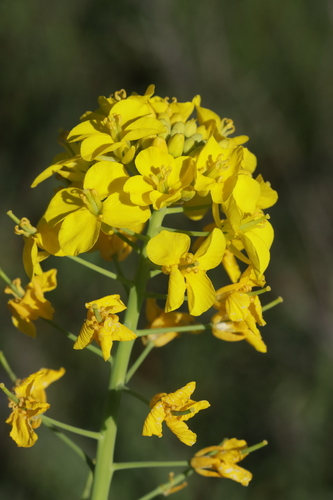
field mustard
Brassica rapa
A burst of golden sunshine in early spring, Field Mustard is a hardy wildflower that serves as a bustling airport for backyard pollinators.
Quick Identification
Size
30-100 cm (12-39 inches) in height; flowers approximately 1-1.5 cm (0.4-0.6 inches) wide
Colors
Bright canary-yellow flowers; medium to dark green leaves, often with a glaucous (blue-green) waxy coating on the stems
Key Features
- Bright yellow 4-petaled flowers in clusters
- Upper leaves completely clasp the stem at their base
- Lower leaves are deeply lobed with a large rounded tip
- Smooth, hairless stems with a waxy texture
- Long, slender seed pods (siliques) that spread outward
When You’ll See Them
Geographic range
Where Does the field mustard Live?
Originally native to the temperate regions of Eurasia, Field Mustard has become a truly global traveler, naturalizing across North America, North Africa, and parts of Australia and East Asia. In the United States and Canada, it is a ubiquitous sight in nearly every province and state, thriving in both rural pastures and neglected urban lots. Its ability to adapt to various soil types has allowed it to establish dense populations across the temperate and subtropical zones of the Northern Hemisphere.
Basemap © OpenStreetMap contributors
Behavior
Field Mustard is a fast-growing annual or biennial plant that plays a critical role in the early spring ecosystem. As one of the first wildflowers to bloom in many regions, it provides a vital source of nectar and pollen for emerging bees, hoverflies, and butterflies. Its growth cycle is highly opportunistic; it quickly colonizes disturbed soils, using its deep taproot to stabilize itself and reach nutrients that other plants might miss.
While often categorized as a weed in agricultural settings, Field Mustard is a fascinating example of botanical resilience. It exhibits 'nyctinasty,' where its flowers and leaves may slightly change orientation between day and night to protect reproductive organs or optimize heat retention. In backyard settings, it acts as a hub of activity, frequently hosting the larvae of Cabbage White butterflies and providing cover for small ground-dwelling insects.
EverydayEarth exclusive
Camera Tips
To successfully capture Field Mustard and its frequent insect visitors, mount your camera on a low-profile stake or a small flexible tripod. Aim for a lens height of about 15 to 20 inches from the ground, focusing specifically on the flower clusters (inflorescences) where pollinators congregate. Because the thin stems of Field Mustard sway significantly in the wind, it is best to set your camera's motion sensitivity to a medium-low level to avoid hundreds of 'false' triggers caused by a breeze, or use a camera with specific 'AI Subject' detection for insects.
For the most striking visuals, utilize the 'Time-Lapse' mode on your backyard camera. Setting an interval of one photo every 10 to 20 minutes allows you to document the plant's rapid growth and the 'sleep' movements of the leaves. This is particularly effective during the peak blooming window in late spring. If your camera supports high-speed triggers, you can capture incredible action shots of honeybees and Cabbage White butterflies as they move from bloom to bloom.
Pay close attention to lighting and background contrast. Field Mustard's yellow is very bright and can easily 'blow out' or lose detail in direct midday sun. Position your camera so it faces away from the sun (shooting with the sun at your back) or target the soft lighting of the early morning. To make the plant pop for the AI's identification features, try to have a darker, out-of-focus background, like a dense hedge or a shaded fence, which will provide a professional-looking contrast against the yellow blossoms.
Similar Species
Species that look similar or are commonly confused with field mustard.
Frequently Asked Questions
Record field mustard at your habitat
Connect a camera to start building your own species record — AI identifies every visitor automatically.