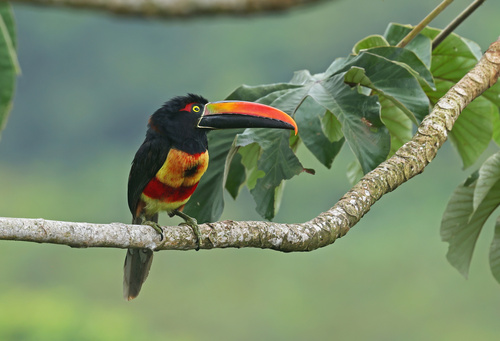
Fiery-billed Aracari
Pteroglossus frantzii
With its neon-orange bill and striking yellow-and-red chest, the Fiery-billed Aracari is a crown jewel of the Central American rainforest. A social and charismatic member of the toucan family, this bird brings a burst of tropical color to any backyard or forest trail.
Quick Identification
Size
Length of 43–45 cm (17–18 in); wingspan approx. 50–55 cm (20–22 in); weight ranges from 225–280 g (8–10 oz).
Colors
Jet black head and neck; dark olive-green back; bright yellow chest with a central black spot and a broad red horizontal band; multi-colored bill featuring bright orange-red, yellow, and black.
Key Features
- Vivid orange and red upper mandible with serrated faux-teeth
- Bright yellow breast with a distinct red band and central black spot
- Social behavior, often seen in groups of 3 to 10
- Pale yellow iris surrounded by bare red skin.
When You’ll See Them
Geographic range
Where Does the Fiery-billed Aracari Live?
Native to the lush tropical corridors of Central America, the Fiery-billed Aracari occupies a relatively narrow and specialized range. It is primarily found along the Pacific slope of southern Costa Rica and western Panama, flourishing in the humid lowlands and foothills. Because it thrives in the transition zones between dense jungle and more open forest edges, this species is a common sight for residents and travelers exploring the Osa Peninsula and the Chiriquí province.
Basemap © OpenStreetMap contributors
Behavior
Fiery-billed Aracaris are highly social and energetic members of the toucan family, typically traveling in noisy family groups of three to ten individuals. They are communal sleepers, often squeezing several adults into a single abandoned woodpecker hole to spend the night together. This social bond is evident in their constant vocalizations—a series of high-pitched "psee-ik" calls that keep the group coordinated as they move through the canopy.
While they spend much of their time high in the trees, they are surprisingly agile and will descend to lower levels to forage for fruit. They interact with humans primarily as curious onlookers in eco-tourism gardens or rural backyards bordering forests. Though generally shy, they can become habituated to feeding stations where fruit is provided, displaying a hierarchy within their group during mealtime.
EverydayEarth exclusive
Camera Tips
To capture the Fiery-billed Aracari, placement is everything. These birds are canopy dwellers that frequently visit the mid-story, so aim your camera at a height of 10 to 15 feet if possible, or position it on a balcony or hillside that looks into the tree line. Angle the lens slightly downward if you are placing it near a known fruiting tree like a Cecropia or a wild nutmeg. Because they move in groups, using a wide-angle lens or a setting with a wider field of view will help you capture the social dynamics of the whole flock rather than just a single bird.
If you are looking to attract them to a backyard setup, a platform feeder stocked with overripe bananas, papaya, or watermelon is nearly irresistible. Place the feeder near a "landing branch"—a clear, horizontal limb where the birds can survey the area before hopping down to eat. This is often where you will get your clearest, most iconic shots. Set your camera to a high-speed burst mode or "Photo + Video" mode; these birds are twitchy and fast, and you’ll want to catch the moment they toss a piece of fruit into the air to swallow it.
Since they are most active in the early morning and late afternoon, ensure your camera’s ISO settings are optimized for the dappled, lower light of the forest edge. In the bright tropical sun, the red and yellow of their plumage can easily "blow out" or overexpose, so if your camera allows for exposure compensation, dial it down by -0.3 or -0.7. If you’re using a trail cam in a remote spot, look for natural "bath tubs"—large bromeliads or hollowed-out logs that collect rainwater—as aracaris love a communal bath during the heat of the day.
Similar Species
Species that look similar or are commonly confused with Fiery-billed Aracari.
Frequently Asked Questions
Record Fiery-billed Aracari at your habitat
Connect a camera to start building your own species record — AI identifies every visitor automatically.