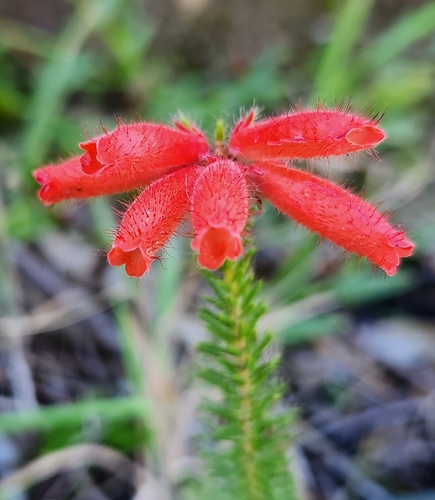
Fire Heath
Erica cerinthoides
The Fire Heath is a vibrant survivor of the African fynbos, famous for its brilliant scarlet bells and its amazing ability to rise from the ashes of wildfires. It serves as a vital nectar hub for sunbirds and adds a dramatic splash of red to rocky landscapes year-round.
Quick Identification
Size
Height ranges from 30 cm to 1 m (12-40 in); flowers are typically 2.5-4 cm (1-1.5 in) long.
Colors
Bright scarlet to deep red flowers; some varieties are pink or white. Foliage is grey-green with fine, silvery hairs.
Key Features
- Dense clusters of drooping, tubular red flowers
- Small, needle-like leaves arranged in whorls of 4 to 6
- Sticky, hairy texture on the exterior of the blooms
- Thick, woody base (lignotuber) for fire survival
When You’ll See Them
Behavior
In terms of social interaction with the ecosystem, the Fire Heath is a primary 'gas station' for nectar-feeding birds. Its tubular flowers are perfectly shaped for the long, curved beaks of sunbirds. The plant also produces a sticky secretion on its flowers, which is believed to act as a defense mechanism to prevent crawling insects, like ants, from stealing nectar without providing pollination services in return.
EverydayEarth exclusive
Camera Tips
Lighting is the most critical factor when photographing this species. The deep scarlet of the petals can become oversaturated or 'blow out' in harsh midday sun, losing the fine detail of the tiny hairs. Aim for the early morning or late afternoon golden hours. This soft, directional light will catch the silvery hairs on the leaves and flowers, creating a halo effect that makes the plant pop against its background.
If you are using an AI-powered camera that recognizes species, set it to alert for 'Birds.' Sunbirds are the most frequent visitors, but you may also catch sugarbirds or even specialized insects. In garden settings, ensure you prune away any long, thin grasses that might sit between the lens and the heath; even a light breeze can cause these to trigger the camera, filling your SD card with 'empty' motion events. For a unique perspective, try a time-lapse setting during the peak spring months to watch the flower heads slowly open and droop over several days.
Similar Species
Species that look similar or are commonly confused with Fire Heath.
Frequently Asked Questions
Record Fire Heath at your habitat
Connect a camera to start building your own species record — AI identifies every visitor automatically.