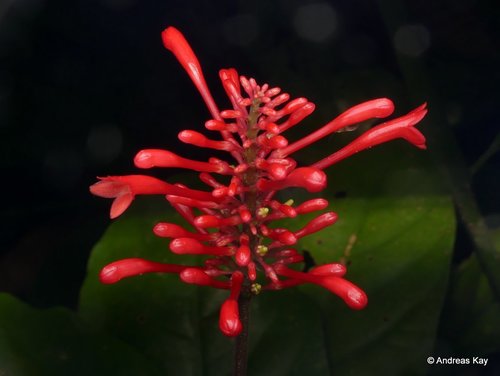
Firespike
Odontonema tubaeforme
A towering beacon of brilliant red, Firespike is the ultimate 'gas station' for hummingbirds and butterflies. This architectural shrub transforms shady garden corners into vibrant wildlife hubs with its stunning waxy floral spikes.
Quick Identification
Size
Height of 4-6 feet (1.2-1.8 m), occasionally reaching 10 feet (3 m); spread of 2-3 feet (0.6-0.9 m)
Colors
Brilliant scarlet or cardinal red flowers; deep glossy green foliage
Key Features
- Upright terminal spikes of waxy, tubular red flowers
- Large, ovate leaves with distinct wavy margins and glossy finish
- Square-shaped stems typical of the Acanthaceae family
- Clumping growth habit that spreads via underground runners
When You’ll See Them
Geographic range
Where Does the Firespike Live?
Firespike is native to the tropical regions of Central America, with its core range extending from Southern Mexico through Panama. Due to its popularity as an ornamental 'wildlife plant,' it has successfully naturalized in numerous warm-climate regions across the globe, including Florida, Hawaii, the Caribbean islands, and parts of Northern Australia. It is a staple of the American Southeast, where it thrives in USDA hardiness zones 8b through 11.
Basemap © OpenStreetMap contributors
Behavior
In the backyard ecosystem, this plant is famous for its 'hummingbird magnetism.' Its tubular flowers are specifically shaped to accommodate the long bills of hummingbirds, who can be seen fiercely defending a single Firespike bush from rivals. While the plant itself is stationary, its growth pattern is assertive, creating dense thickets that provide essential thermal cover and nesting sites for small birds and hunting grounds for lizards.
EverydayEarth exclusive
Camera Tips
To successfully capture wildlife on your Firespike, your camera placement should focus on the 'nectar zone'—the top third of the plant where the flower spikes are most abundant. Position your camera on a tripod or mount it to a nearby fence at a height of 4 to 5 feet, angling it slightly downward so the tubular flowers are centered in the frame. This 'eye-level' view is perfect for catching the hovering action of hummingbirds and the delicate landing of butterflies like the Cloudless Sulphur.
Because Firespike flowers are a saturated, waxy red, they can easily cause 'color clipping' or lose detail in direct, harsh sunlight. For the best AI identification results, place your camera where the plant receives bright, indirect light or dappled morning sun. This softer lighting brings out the texture of the petals and the deep veins of the leaves, helping the AI distinguish the red flowers from the visiting red-throated hummingbirds.
Adjust your camera's motion sensitivity to 'High.' Hummingbirds move with incredible speed and can enter and exit the frame in a matter of seconds. If your camera has a 'Pre-Roll' or 'Burst Mode' feature, enable it to ensure you catch the approach. Don't forget to check the lower leaves in your frame as well; the large, broad foliage of the Firespike is a favorite sunning spot for Anoles and other garden lizards who wait there to ambush smaller insects.
Frequently Asked Questions
Record Firespike at your habitat
Connect a camera to start building your own species record — AI identifies every visitor automatically.