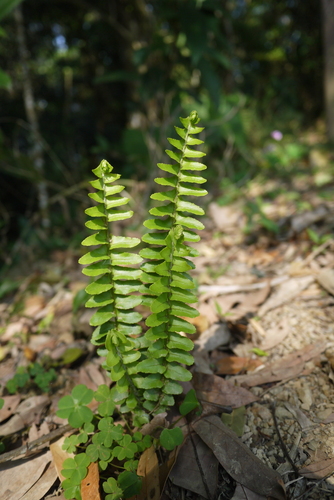
Fishbone Fern
Nephrolepis cordifolia
The Fishbone Fern is a resilient and architectural masterpiece of the plant world, easily recognized by its ladder-like fronds. Whether it's providing a hidden highway for backyard critters or brightening a shady corner, this fern is a testament to nature's adaptability.
Quick Identification
Size
Fronds typically grow 20–100 cm (8–40 inches) in length and 5–8 cm (2–3 inches) in width
Colors
Bright lime green to deep emerald green fronds with brownish-orange spore patches (sori) on the underside; brownish scales on the central stem
Key Features
- Erect, sword-shaped fronds with a distinct 'fishbone' or ladder-like appearance
- Presence of small, round, underground tubers on the roots
- Neatly arranged leaflets (pinnae) with slightly serrated edges
- Dense, clump-forming growth habit
When You’ll See Them
Behavior
The Fishbone Fern is an incredibly hardy and opportunistic plant known for its aggressive growth and ability to thrive in varied conditions. Unlike many delicate ferns, it spreads rapidly using both airborne spores and underground runners (rhizomes). Its most distinctive behavioral trait is the production of small, fleshy tubers on its roots, which act as water storage organs, allowing the plant to survive through dry spells that would kill other fern species.
In a backyard ecosystem, the Fishbone Fern acts as both a colonizer and a provider. It often forms dense, lush mats that create a micro-habitat for small invertebrates and amphibians. While prized in many gardens for its vibrant green 'fountain' shape, it is considered a significant environmental weed in several regions due to its ability to outcompete native vegetation and dominate the forest floor.
EverydayEarth exclusive
Camera Tips
Because the Fishbone Fern creates such dense ground cover, it is a prime location for setting up a camera to capture 'low-profile' wildlife. Position your camera about 6 to 12 inches off the ground, angled slightly downward into a clearing at the edge of the fern clump. This is where small mammals like shrews, rats, or even ground-foraging birds like thrushes will emerge from the safety of the fronds into the open.
For those interested in the plant's own life cycle, use a time-lapse setting to capture the 'unfurling' of new fronds, known as fiddleheads. Set your camera to take one photo every 2 to 4 hours over a period of two weeks during the rainy season. This reveals the fascinating, spiral-like movement as the plant expands. Ensure your camera is set to a macro or close-focus mode if available, as the texture of the brownish scales on the stipe (stem) provides beautiful detail.
Lighting can be tricky with ferns because their glossy leaves can cause 'hot spots' or glare in direct sun. Aim to place your camera so the fern is in dappled light or shade. This prevents the AI from being blinded by high-contrast reflections and ensures the deep greens of the plant are captured accurately. If you are using a trigger-based camera, the movement of the fronds in high wind can sometimes cause 'false triggers'; lower the sensitivity of your motion sensor if you notice dozens of empty videos on windy days.
Frequently Asked Questions
Record Fishbone Fern at your habitat
Connect a camera to start building your own species record — AI identifies every visitor automatically.