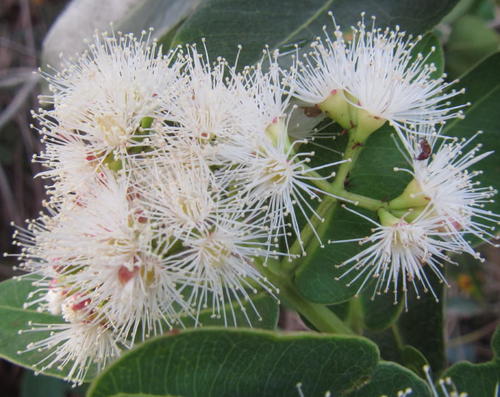
Forest Waterberry
Syzygium gerrardii
A majestic giant of the Southern African mist-belt, the Forest Waterberry is a life-sustaining hub that draws in colorful turacos, curious monkeys, and a wealth of pollinators.
Quick Identification
Size
A large evergreen reaching 10–30m (33–100ft) in height with a trunk diameter up to 1.5m (5ft).
Colors
Glossy dark green leaves, creamy-white flowers, and deep purple to black oval fruits.
Key Features
- Large evergreen tree with a frequently buttressed base
- Glossy dark green leaves with distinct drip-tips
- Creamy white flowers with a 'pincushion' of long stamens
- Oval-shaped purple-black berries about 1cm long
When You’ll See Them
Geographic range
Where Does the Forest Waterberry Live?
The Forest Waterberry is a quintessential Southern African species, deeply rooted in the moist, high-rainfall regions of the continent. It is primarily found along the eastern escarpment of South Africa, stretching from the Eastern Cape through KwaZulu-Natal and into Limpopo, while also maintaining a strong presence in the mist-belt forests of Eswatini and parts of southern Mozambique. This tree thrives where moisture is abundant, often marking the transition between deep forest and mountain grasslands.
Basemap © OpenStreetMap contributors
Behavior
The Forest Waterberry is a keystone species in its ecosystem, acting as a vertical neighborhood for a vast array of forest life. While the tree itself is stationary, its 'behavior' is defined by its phenology; it produces massive displays of nectar-rich flowers followed by heavy crops of succulent fruits. These cycles dictate the movement of local wildlife, turning the tree into a high-traffic hub for pollinators during the spring and a feast for frugivores in the late summer and autumn.
In a garden or forest setting, the tree provides a dense, year-round canopy that serves as a vital thermal refuge. During the heat of the day, birds and small mammals seek out its cool shade, while at night, the thick foliage offers protection from predators and wind. Its root system is particularly adept at stabilizing soil near watercourses, contributing to the health of riverine environments.
EverydayEarth exclusive
Camera Tips
To capture the incredible diversity of life visiting a Forest Waterberry, position your AI camera with a focus on the fruiting clusters rather than the trunk. Since this is a tall tree, using a long-range mount or placing the camera on a nearby structure to get a 'canopy-level' view is highly effective. If your tree is young or has low-hanging branches, aim the camera at the outer edges of the foliage where birds like Knysna Turacos or Purple-crested Turacos are most likely to land to feed.
For those interested in mammalian visitors, place a camera near the base of the tree. Many species, such as Bushbuck or Samango monkeys, will visit to forage for fallen fruit on the forest floor. Ensure your camera is set to a high-trigger speed to catch the fast movements of forest birds. Because these trees often grow in shaded, 'dark' forest environments, choosing a camera with excellent low-light performance or high-quality infrared flash for night shots is essential for identifying nocturnal visitors like Genets or Fruit Bats.
If your camera is AI-powered, train it to recognize movement within the leaves. The white flowers attract a swarm of bees and butterflies during the day, which in turn brings in insectivorous birds. Setting your camera to record short video clips rather than still photos will help you capture the social interactions, such as Barbets or Hornbills competing for the best fruit clusters. During the peak fruiting season from January to May, expect your camera to be very busy!
Frequently Asked Questions
Record Forest Waterberry at your habitat
Connect a camera to start building your own species record — AI identifies every visitor automatically.